
What is AWS Marketplace?
AWS Marketplace is a digital storefront where software companies list products and AWS customers purchase them using their existing AWS billing relationship. It supports SaaS applications, Amazon Machine Images (AMIs), container-based products, machine learning models, AI agents, data products through AWS Data Exchange, and professional services. Over 42,000 products are currently listed.
New to the channel? Our overview of AWS Marketplace for sellers explains how the seller motion works before this guide walks through the steps.
What are the benefits of selling on AWS Marketplace?
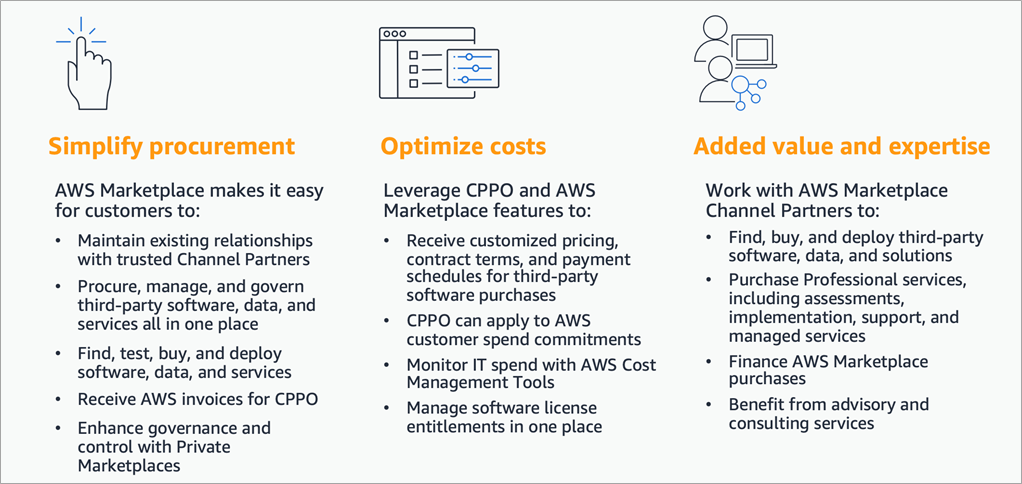
The benefits of selling on AWS Marketplace come down to access: access to pre-committed enterprise cloud budgets, dramatically faster procurement cycles, co-sell support from AWS field teams, and global reach without building international billing infrastructure.
Enterprise software sales through cloud marketplaces reached $30 billion in 2024. Omdia projects $163 billion by 2030 at a 29.1% CAGR, with agentic AI transactions alone projected to drive $24.4 billion. Enterprises now hold close to $470 billion in committed cloud spend across AWS, Microsoft, and Google — and a growing share flows through marketplace procurement.
The implication for ISVs is straightforward. Procurement teams are consolidating vendor purchases through cloud providers they already pay. If your software is on AWS Marketplace, it becomes part of a budget that's already approved. If it's not, you're competing for a separate line item.
What are EDP commitments on AWS Marketplace?
Enterprise Discount Program (EDP) commitments are multi-year agreements where an organization commits to a set AWS spend level in exchange for volume discounts. When a buyer has millions committed to AWS and needs qualified purchases to draw down that commitment before expiration, AWS Marketplace purchases can qualify against their commitments.
That changes the entire sales conversation. You're no longer asking a buyer to find new budget. You're helping them spend the budget they've already committed.
How does AWS Marketplace accelerate enterprise procurement?
AWS Marketplace accelerates enterprise procurement from months to weeks by eliminating new vendor onboarding, separate invoicing, and independent legal review — the buyer transacts on their existing AWS billing relationship with pre-approved terms.
Traditional enterprise procurement runs through a predictable sequence: new vendor onboarding, legal review, security questionnaire, procurement committee approval, purchase order issuance, NET-60 payment terms. Each step adds days or weeks. Marketplace compresses most of this:
- The buyer's existing AWS billing relationship covers the transaction — no new vendor setup required.
- Private offer acceptance creates a binding agreement directly on the buyer's existing AWS account.
- Deals that take three to four months through traditional procurement can close in weeks.
- AWS field sellers are financially incentivized to support your deals — the ISV Accelerate program provides cash incentives to AWS sales teams who co-sell partner solutions through Marketplace private offers.
Global reach without global infrastructure
AWS handles multi-currency billing, localized tax compliance, and regional regulatory frameworks on behalf of sellers. A 50-person SaaS company can sell into EMEA, APAC, and LATAM through Marketplace without building international billing, invoicing, or tax infrastructure. For mid-market ISVs, this removes a barrier that would otherwise require significant investment to clear.
What can you sell on AWS Marketplace?
You can sell SaaS applications, Amazon Machine Images (AMIs), container-based products, machine learning models, AI agents, data products, and professional services on AWS Marketplace. Your product type determines your technical integration, available pricing models, and how deal structures work downstream.
Product types and delivery models
AWS Marketplace supports seven product types, each with different delivery methods, integration requirements, and buyer experiences.
| Product type | What it is | Best for |
|---|---|---|
| SaaS | Application runs in your infrastructure; AWS handles subscription management, entitlement, billing | Most B2B software |
| AMI | Virtual machine images deployed on Amazon EC2 | Applications requiring customer-side compute |
| Containers | Docker images deployed on Amazon ECS or EKS | Containerized workloads and microservices |
| ML Models | Deployed through SageMaker | AI, analytics, data science |
| AI Agents | Deployed via API or container in the dedicated AI Agents and Tools category (launched mid-2025) | Agentic AI products |
| Data Products | Distributed through AWS Data Exchange | Datasets, data feeds, data APIs |
| Professional Services | Consulting, implementation, training, managed services — transacted through private offers | Service delivery |
What are AI agents on AWS Marketplace?
AI agents are one of the fastest-growing categories. The dedicated AI Agents and Tools category creates a distinct discovery path that didn't exist a year ago. Omdia projects agentic AI will be one of the highest-growth segments across all cloud marketplaces through 2030. If your product has an agentic AI component, this category gives you a dedicated entry point worth building around.
How much does AWS Marketplace cost?
AWS charges a percentage-based transaction fee on each Marketplace sale: 3% for SaaS public offers, tiered rates of 1.5–3% for private offers based on total contract value, and 20% for server-based listings (AMI, container, ML). Sellers receive monthly disbursements and never invoice customers directly.
Before you invest in listing, you need a clear picture of three things: what Marketplace costs, how pricing works, and how you get paid.
What fees does AWS Marketplace charge?
AWS charges a percentage of each transaction, calculated on pre-tax total contract value. These rates have been in effect since January 5, 2024.
| Category | Fee |
|---|---|
| SaaS and Data Exchange (public offers) | 3% |
| Server listings (AMI, container, ML) | 20% |
| Private offers under $1M TCV | 3% |
| Private offers $1M–$10M TCV | 2% |
| Private offers $10M+ TCV | 1.5% |
| All renewals | 1.5% |
| Professional services | 2.5% |
| CPPO uplift (any offer type) | +0.5% |
| South Korea regional fee | +1% (effective April 2025) |
Two things catch ISVs off guard. First, the server listing fee is a flat 20% — not the 3% that SaaS sellers pay. Second, the tiered private offer rates reward volume: as TCV increases, your effective rate decreases. This is why most enterprise revenue eventually flows through private offers, not public listings.
What pricing models does AWS Marketplace support?
AWS Marketplace supports six pricing models: monthly subscription, annual subscription, usage-based metering, contract pricing (1–36 months), hybrid (base plus variable usage), and Bring Your Own License (BYOL).
| Model | Best for | Key consideration |
|---|---|---|
| Monthly/annual subscription | Horizontal SaaS, seat-based pricing | Simplest to implement, most familiar to buyers |
| Usage-based (metered) | Infrastructure tools, API products, data pipelines | Requires robust metering integration; calls must be idempotent |
| Contract pricing | Enterprise deals with committed terms | Supports 1-month, 12-month, 24-month, and 36-month terms |
| Hybrid | Products with baseline + variable consumption | Combines base subscription with usage charges |
| BYOL | Migration scenarios | Lets buyers bring existing licenses to Marketplace |
Note: once you publish your listing — even to limited visibility for testing — you cannot change the pricing model. This decision is permanent for that listing. If you need a different model later, you'll need a new listing entirely. Choose with your downstream deal structures in mind, not just your current billing pattern.
How do AWS Marketplace disbursements work?
AWS bills the buyer, collects payment, and disburses to the seller monthly. You never invoice customers directly — this eliminates late payment risk but ties cash flow to AWS's disbursement timeline.
What you need to know:
- Revenue appears in AWS Marketplace Revenue Reports.
- As of May 2025, AWS processes partial disbursements for partially paid invoices (previously sellers waited for complete payment).
- In January 2026, AWS launched collection visibility reporting for better insight into payment status.
- Reconciliation involves parsing disbursement files, matching transactions to internal records, and handling refunds and credits.
At low deal volume, reconciliation is manageable. At scale, it becomes a significant operational workload. This is where Cloud GTM platforms like Suger automate disbursement reconciliation, matching marketplace payouts to internal records and feeding clean data to your finance stack.
How to list on AWS Marketplace

Listing on AWS Marketplace involves seller registration, product and pricing configuration, listing content creation, technical integration, and AWS review — a process that takes 2–4 weeks end-to-end for most ISVs. Getting listed and building your co-sell motion are parallel tracks that converge when you start running private offers with AWS field support.
What are the requirements to sell on AWS Marketplace?
Some of the requirements you need to get listed on AWS Marketplace are:
- A dedicated business AWS account (not personal, not root credentials)
- IAM role structure with Marketplace management permissions
- Legal entity name, public display name, customer support contact
- Banking details for revenue disbursements
- Tax documentation for your country of incorporation
Registration happens through the AWS Marketplace Management Portal (AMMP). AWS validates your legal entity, tax ID, banking information, and region eligibility. Your country of incorporation must appear on the AWS-supported seller list.
The most common stall point: you must associate your bank account with a disbursement preference before you can create any public or private offers. Many companies lose weeks because they start tax and banking setup after beginning listing work. Submit banking and tax documentation early — this bottleneck has no technical workaround.
Cloud GTM platforms like Suger handle the listing and integration process end-to-end, compressing what typically takes 6–8 weeks of internal effort into 5–10 business days.
How to optimize your AWS Marketplace listing
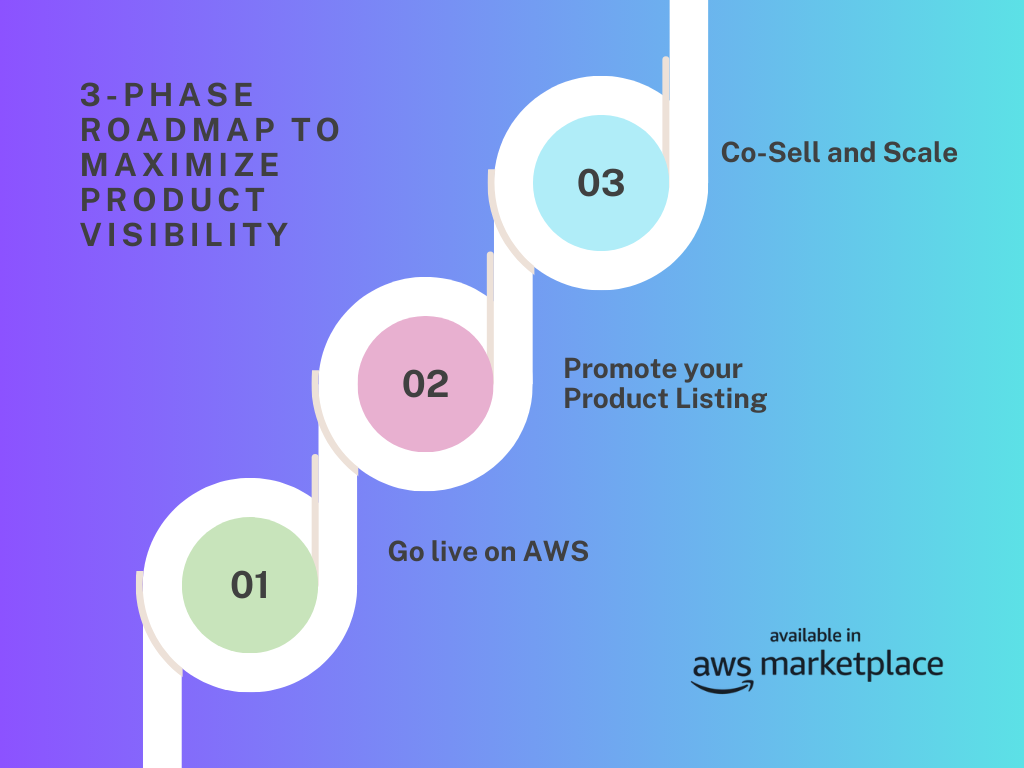
To optimize your AWS Marketplace listing, you must include:
- Product title, summary, and long-form description
- Key features, benefits, and use cases
- Supported AWS regions and system requirements
- Architecture diagrams
- Pricing details and support information
Listing quality matters for two reasons:
Discoverability. Keywords in your title and description drive search placement. "Automated cloud cost optimization for AWS workloads" outperforms "comprehensive platform for enterprises." Think about what an enterprise buyer would type into Marketplace search and work backward.
Field seller engagement. AWS field sellers evaluate your listing before deciding to support a co-sell deal. A thin or generic listing reduces the likelihood they'll engage. Architecture diagrams showing how your product integrates with common AWS services improve both buyer confidence and field seller interest.
Don't treat listing as a launch-and-forget milestone. Companies that actively update content, reflect new features and use cases, and optimize based on performance data see compounding returns. Companies that list and walk away see minimal traction. A Cloud GTM platform like Suger lets you manage and update listings across AWS, Azure, and Google Cloud Marketplace from a single interface, so listing maintenance doesn't require logging into separate marketplace consoles.
What is the AWS Foundational Technical Review (FTR)?
The AWS FTR is a self-service review where AWS validates your solution against Well-Architected best practices across security, reliability, and operational excellence. It's valid for three years.
FTR is the mechanism through which you earn Validated status on the AWS Software Path — and Validated or Differentiated status is a prerequisite for ISV Accelerate. Without ISV Accelerate, you don't have access to the co-sell motion that drives the largest Marketplace deals.
What FTR unlocks:
- Validated status → ISV Accelerate eligibility → co-sell with AWS field sellers
- Listing in the AWS Partner Solutions Finder
- Visibility in AWS's internal sales discovery tools (how field sellers find partners to co-sell with)
- Access to funding programs and AWS Competency designations
- A "Qualified Software" badge
How long does it take to get listed on AWS Marketplace?
For SaaS and AMI products, AWS states the publication process takes 7–10 business days assuming no errors. AWS's broader guidance recommends planning for 2–4 calendar weeks end-to-end, with 45 days of lead time for planned launches.
Once your listing and technical integration are ready, you request public visibility through the AMMP. Seller Operations reviews your submission across product functionality, documentation accuracy, security posture, pricing correctness, and Marketplace compliance.
After approval, validate everything:
- End-to-end test purchases
- Entitlement activation and cancellation flows
- Metering data accuracy
- Earnings in AWS Marketplace Revenue Reports
Then brief your sales, CS, and partner teams on how to position Marketplace procurement during deals. If your GTM team doesn't know how to present the Marketplace option, utilization stays low regardless of technical performance.
Companies using a Cloud GTM platform like Suger typically go live in 5–10 business days from submission, because technical integration, listing submission, and review cycles run through pre-built marketplace connections that require zero engineering.
Concurrent Agreements: Since June 1, 2026, every new SaaS product must support Concurrent Agreements, so build it into your technical requirements from the start.
AWS Marketplace offers: public, private, and channel partner (CPPO)
AWS Marketplace transactions happen through three primary paths: public offers visible to any buyer, private offers with custom terms for specific buyers, and channel partner private offers (CPPO) where resellers transact on the ISV's behalf. A fourth mechanism — agreement-based offers — lets you modify deals mid-contract.
| Deal path | What it is | When to use it |
|---|---|---|
| Public offer | Default pricing visible to any buyer | Self-service, PLG, buyers who don't need custom terms |
| Private offer | Custom deal for a specific buyer | Enterprise deals, negotiated pricing, multi-year commitments |
| CPPO | Channel partner extends a private offer on the ISV's behalf | Partner-led sales, regional coverage, bundled services |
| Agreement-based offer (ABO) | Mid-contract modification to an existing private offer | Expansions, true-ups, term changes |
What are public offers on AWS Marketplace?
A public offer is the default: the pricing, terms, and entitlements visible to any buyer who visits your listing. The buyer experience is simple — review, subscribe, deploy — and can happen in a single session. AWS handles billing through the buyer's existing account.
Public offers work well for self-service purchases and product-led growth (PLG) motions. They're how most ISVs start transacting and establish the baseline that private offers build on.
What are private offers on AWS Marketplace?
A private offer is a custom deal created for a specific AWS buyer with negotiated pricing, payment schedules, term lengths, and contract language. When accepted, it becomes a binding agreement.
Most high-value enterprise Marketplace transactions flow through private offers, not public listings. A Cloud GTM platform like Suger lets your team create, approve, and track private offers directly from Salesforce — no AWS portal login required. The offer workflow lives where your reps already work.
What are agreement-based offers (ABOs)?
ABOs let you modify an existing private offer mid-contract without starting over. You can amend pricing, add product dimensions, adjust payment schedules, or extend terms. The buyer accepts through the standard Marketplace workflow.
Without ABOs, every expansion requires a completely new offer — adding overhead and delay to what should be a straightforward upsell. ABOs have become essential for enterprise deal management where mid-contract flexibility is expected.
What is CPPO on AWS Marketplace?
CPPO (Channel Partner Private Offers) allows approved channel partners to extend private offers to buyers on your behalf. The ISV sets the terms and issues a selling authorization. The partner accepts, marks up from wholesale cost, and extends the offer to the buyer. CPPO adds a 0.5% fee uplift.
Common use cases:
- Implementation partners bundling services with your software
- Resellers with established enterprise relationships in accounts you can't cover directly
- Regional partners providing local billing in EMEA, APAC, or LATAM
- Partners wrapping professional services around your SaaS product
CPPO introduces a third party into every transaction — which makes margin calculations, partner authorization tracking, and revenue attribution more complex. At low partner volume, manageable. As you add partners, each with their own buyers and deal structures, the operational surface area grows fast.
How to co-sell with AWS
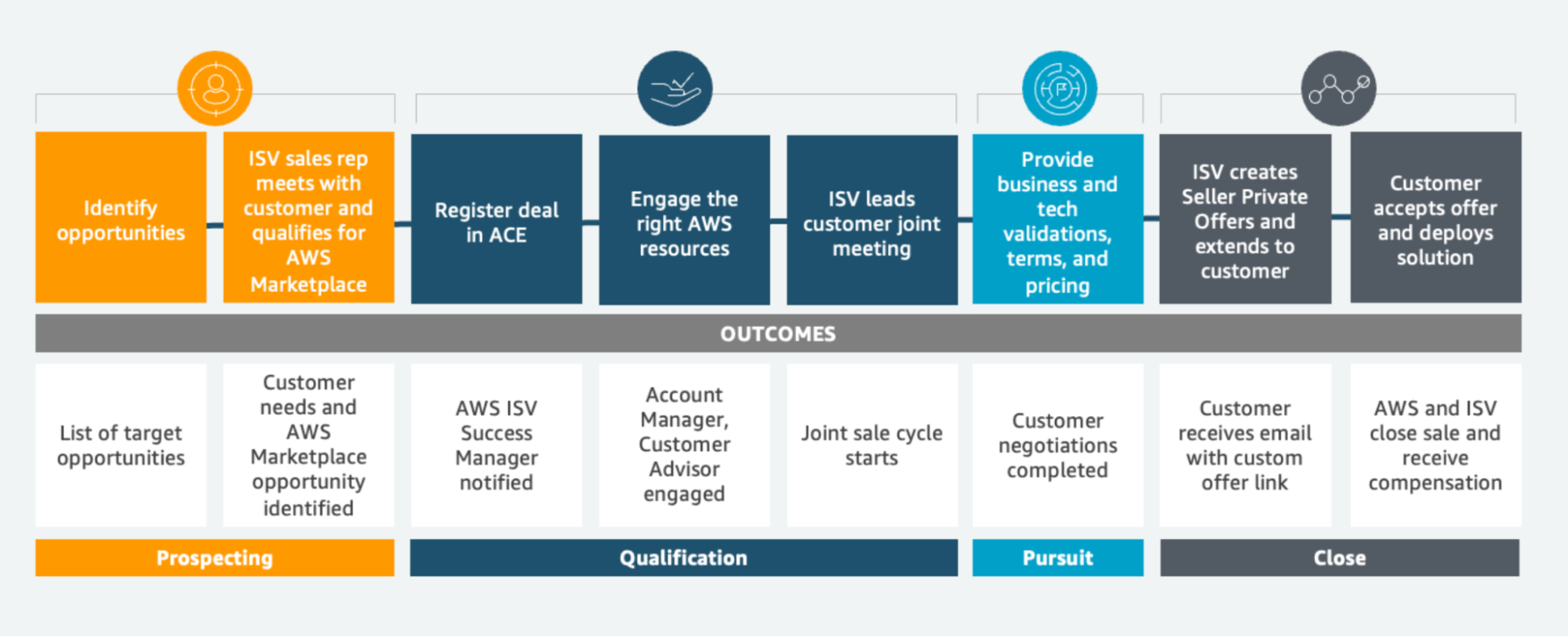
Co-selling with AWS means working through the ISV Accelerate program and the ACE pipeline system, where you register opportunities, AWS validates them, and AWS field sellers engage qualified accounts alongside you. It's the highest-leverage growth motion on Marketplace — but it runs through specific programs and systems that require deliberate investment.
APN Partner tiers and what they unlock for ISVs
The AWS Partner Network organizes Software Path partners through a progression: Registered → Confirmed → Validated → Differentiated.
Validated status is the threshold that matters most. It unlocks ISV Accelerate eligibility, which is where co-sell becomes operational. You achieve Validated status by completing the FTR — which is why the technical review is strategically important even though it's not required to list.
The dynamic is self-reinforcing: a strong listing and Validated status attract field seller engagement, which generates pipeline, which drives more field engagement, which builds toward Differentiated status and larger programs.
What is the AWS ISV Accelerate program?
ISV Accelerate is the program that makes co-sell work. AWS account managers receive cash incentives for co-selling your solutions through Marketplace private offers.
Qualification requirements:
- At least one software product listed as GA on Marketplace
- ACE program eligibility
- Validated or Differentiated status in Partner Central
- Amazon Payee Central account
- Minimum 5 launched opportunities (ACE or Marketplace private offers) in the past 12 months
- Minimum 15 qualified opportunities in ACE in the past 12 months
- At least one person having completed the Co-Selling with AWS learning module
- Minimum $2,000 in recognized AWS account revenue at enrollment
What is ACE?
ACE (APN Customer Engagements) is AWS's co-sell pipeline system where ISVs register opportunities, AWS validates them based on customer cloud usage and revenue alignment, and AWS field sellers engage qualified accounts with introductions, deal coaching, and procurement support. For AWS-referred opportunities, partners have 5 business days to accept or reject.
- Register an opportunity in ACE.
- AWS validates based on customer cloud usage, service fit, and revenue alignment.
- If validated, AWS sellers engage the account — introductions, deal coaching, procurement support.
- Deal closes through Marketplace, AWS rep gets credit.
The operational challenge: keeping ACE data in sync with your CRM becomes critical as concurrent co-sell opportunities grow. Without integration, attribution is unreliable and leadership can't answer how much pipeline is partner-sourced versus partner-influenced.
Suger syncs co-sell opportunities between your CRM and ACE in real time — deal registration, status updates, and attribution flow automatically without manual re-entry.
What's changing with AWS Partner Center in 2026?
AWS made three significant changes to Partner Central, the comprehensive portal for managing your entire AWS partnership in 2026: migrating the platform into the AWS Console, launching AI-powered Partner Central agents, and adding MCP server support for CRM integration.
Console migration. Partner Central has moved into the AWS Console, consolidating partner tools, opportunity management, and program enrollment into the same interface you use for AWS infrastructure. New capabilities are being built exclusively for the console-based interface — if you haven't migrated, prioritize it.
Partner Central agents. Launched March 2026, these Amazon Bedrock AgentCore-powered agents automate administrative tasks across co-selling, funding, and opportunity management. Partners can ask an agent to identify deals needing attention, surface funding eligibility, generate sales plays, or auto-populate opportunity fields from meeting notes.
MCP server support. Partner Central agents support Model Context Protocol servers, letting you connect existing CRM and internal tools directly to agentic capabilities. Partner Central intelligence reaches your sales team inside the tools they already use, rather than requiring context-switching into a separate portal.
Suger already integrates with Partner Central's agentic capabilities, letting teams leverage these new automation features without building custom connections. The pattern: AWS is investing heavily in making co-sell workflows faster, more automated, and less dependent on manual data entry.
AWS Marketplace funding programs and ISV incentives
AWS offers ISVs several funding programs including List and Sell ($10,000 in credits), Seller Prime (up to $40,000 in marketing funds), ACE-CRM Integration Credits ($10,000), and migration programs like MAP and WMP. What's available depends on your stage of Marketplace maturity.
Early-stage programs
Two programs target ISVs getting their first listing live and closing initial Marketplace deals.
| Program | What you get | How to qualify |
|---|---|---|
| List and Sell | $10,000 in promotional credits | $65K TCV or 10 private offers within 12 months (yearly contract); $5,500 revenue or 10 active monthly subscriptions (PLG). Requires participating AWS Marketplace Partner. |
| MPOPP | Pre-loaded MDF wallets and promotional support | Part of the Global Startup Program (announced re:Invent 2025); targets startups closing first enterprise Marketplace deals |
Growth programs
Two programs support ISVs scaling their marketplace motion and investing in operational infrastructure.
| Program | What you get | How to qualify |
|---|---|---|
| Seller Prime | GTM enablement kit, marketing support, up to $40,000 in reimbursable marketing funds, listing performance dashboards | Strategy document aligned with Seller Prime team; PLG-motion SaaS companies |
| ACE-CRM Integration Credits | $10,000 in AWS credits | Complete a new CRM integration to Marketplace or co-sell portal; at least one private offer acceptance from CRM or one co-sell submission |
Seller Prime is notably the only way ISVs get granular listing visibility — traffic volumes, conversion rates, marketing channel breakdowns. Without it, you're operating on revenue data alone without top-of-funnel analytics.
Migration and workload programs
Two programs provide credits for ISVs whose products are part of customer migration or modernization projects.
| Program | What you get | When it applies |
|---|---|---|
| MAP (Migration Acceleration Program) | Credits for customers migrating workloads to AWS | Your product is part of a customer's migration or modernization project; expanded in late 2025 to cover generative AI and app modernization |
| ISV WMP (Workload Migration Program) | Direct credit disbursement to end customers | Customers moving workloads to AWS; updated January 2026 |
The throughline across all programs: AWS rewards ISVs who actively build their Marketplace business. The operational infrastructure you have in place — CRM integration, co-sell pipeline, offer management — determines how much of that funding you can actually capture.
Common AWS Marketplace challenges and how to solve them
The most common AWS Marketplace challenges are: private offer workflows breaking at scale, co-sell data fragmenting across ACE and your CRM, finance struggling to reconcile marketplace disbursements, and multi-cloud operations multiplying every manual process. Each maps to a specific stage of maturity — and each has a clear fix.
Private offer volume breaks manual workflows
The first few deals close through manual effort. Someone logs into the marketplace console, builds the offer, emails the buyer, waits for acceptance, updates the CRM. At 5+ offers per month:
- Approvals get lost in email threads
- Offers expire before buyers accept
- Pricing errors surface
- The team creating offers becomes a bottleneck
What to do: Build approval workflows with clear routing. Set pre-approved pricing thresholds so standard deals move without manual sign-off. Connect offer creation to your CRM so reps work from one system using Cloud GTM platforms like Suger.
Co-sell data fragments across systems
Opportunities registered in ACE are disconnected from your CRM. Attribution becomes unreliable. Leadership can't answer basic questions about partner-sourced versus partner-influenced pipeline.
What to do: Integrate co-sell systems with your CRM using Suger so deal registration and status sync automatically. Define attribution rules before volume makes retroactive classification impossible. Run regular data audits to catch sync gaps early.
Finance can't reconcile marketplace revenue
AWS has different disbursement timing and reporting formats than your direct sales motion. Revenue recognition requires its own policy — disbursement timing, fee netting, and multi-year contract structures don't map cleanly to how most finance teams handle direct deals.
What to do: Define rev rec policy for marketplace transactions before deal volume makes it urgent. Set up disbursement tracking that maps cloud provider payouts to internal records. Involve finance in Cloud GTM planning from the start. A platform like Suger automates disbursement tracking and reconciliation across all three clouds, giving finance clean data without manual effort.
Multi-cloud multiplies everything
Each additional marketplace — Azure, GCP — adds a separate console, co-sell system, reporting stream, and disbursement process. The operational model you built for AWS needs to work across two or three clouds.
What to do: Treat the second marketplace launch as process replication, not a net-new build. Centralize reporting and offer management across clouds before adding the third. Evaluate whether your current tooling supports multi-cloud or whether a unified platform like Suger is the right investment.
Best tools and platforms for AWS Marketplace sellers
Cloud GTM platforms like Suger automate the operational work of selling through AWS Marketplace: listing management, private offer workflows, co-sell synchronization, and revenue reconciliation. This matters because that operational work grows linearly with deal volume when managed manually, and the scaling curve becomes unsustainable without automation.
When do you need a Cloud GTM platform?
You typically need a Cloud GTM platform when private offer volume exceeds beyond a certain point, co-sell data fragments across ACE and your CRM, finance spends hours reconciling marketplace disbursements, or you're launching on a second cloud marketplace. These are signals that the operational cost of manual management exceeds what a platform would cost.
Six signals that it's time:
- Your listing requires engineering resources — building and maintaining direct marketplace API integrations takes ongoing engineering time a platform eliminates.
- Private offer volume is climbing — manual creation in the AMMP becomes a bottleneck.
- Co-sell motion is scaling — keeping ACE data in sync with your CRM manually means attribution stays unreliable.
- Finance is spending hours on reconciliation — each deal adds disbursement tracking, fee matching, and reporting work.
- You're launching on a second marketplace — a separate console, co-sell system, and reporting stream doubles operational overhead.
- Reps avoid marketplace deals — if the workflow is slower than their standard CRM process, the channel stalls.
If you're experiencing several of these, the operational cost of manual Cloud GTM is likely exceeding what a platform would cost — and you're losing revenue to the friction.
What to look for in a Cloud GTM platform
The right Cloud GTM platform covers the full lifecycle of marketplace selling. These are the capabilities that matter most when evaluating options.
| Capability | What to evaluate |
|---|---|
| Marketplace coverage | AWS, Azure, GCP at minimum; some platforms support Snowflake or emerging marketplaces |
| Private offer workflows | Can your team create, route, approve, and track offers from within your CRM? |
| Co-sell automation | Bi-directional sync between CRM and ACE / Partner Center / PSC? Automatic deal registration? |
| Quote-to-cash depth | How far past listing and offers does it extend — CPQ, metering, billing, disbursement tracking, ERP sync? |
| CRM and finance integrations | Salesforce and HubSpot are baseline; does it connect to your billing system, accounting software, data warehouse? |
| AI and automation | Can it automate co-sell field population, offer creation from CRM data, deal routing, renewal triggers? |
How does Suger fit AWS Marketplace operations?
Suger is built for automating the full lifecycle of AWS Marketplace operations, from listing through revenue reconciliation. It covers that lifecycle in a single system: listing, private offers, co-sell, CPQ, metering, billing, revenue reconciliation, and ERP sync. Which platform is right for you depends on your own requirements — work through the evaluation framework rather than taking any vendor's summary of the category, including this one.
What Suger does here:
- Quote-to-cash automation. Connects the deal flow from CPQ quote to marketplace offer to entitlement to revenue recognition, so finance teams get revenue data without reconciling across systems.
- Usage metering and billing flexibility. Meters consumption across AWS, Azure, and GCP from a single interface, with data flowing directly into billing systems like Stripe, Metronome, Orb, and Chargebee. Teams can offer consumption pricing without building custom metering infrastructure.
- Multi-cloud coverage. Supports six marketplaces (AWS, Microsoft, Google Cloud, Snowflake, Alibaba Cloud, and Oracle). Listings, offers, co-sell, and reporting run from one system with 25+ native integrations.
300+ software companies use Suger, including Intel, Snowflake, Notion, Webflow, and Fivetran. Named customers report 3x growth in AWS Marketplace or co-sell volume (Fireblocks, Aikido Security). Separately, CrowdStrike measured AWS Marketplace transactions running 140% larger than direct deals — a marketplace-wide benchmark, not a Suger result.
This guide covered the full Marketplace journey: why it matters, what it costs, how to list, how deals work, how co-sell scales, what programs are available, and what breaks as you grow. The pattern across every section: things start manual and eventually need automation as deal volume, partner count, and operational complexity increase. Suger helps ISVs operationalize everything this guide describes — from listing to private offers to co-sell to revenue reconciliation. If you're ready to make Marketplace a core part of your go-to-market, talk to us.
Frequently asked questions
What is AWS Marketplace? +
AWS Marketplace is a digital storefront where software companies list products and AWS customers purchase them using their existing AWS billing relationship. It supports SaaS, AMIs, containers, ML models, AI agents, data products, and professional services.
How long does it take to list on AWS Marketplace? +
AWS states 7–10 business days for SaaS and AMI publication assuming no errors. Plan for 2–4 weeks end-to-end. AWS recommends 45 days lead time for planned launches. A Cloud GTM platform like Suger takes a submitted listing live in 5–10 business days.
What percentage does AWS Marketplace take? +
3% for SaaS public offers. Private offers are tiered: 3% under $1M, 2% for $1M–$10M, 1.5% above $10M. Renewals are 1.5%. Server listings (AMI, container, ML) are 20%. CPPO adds 0.5%. Professional services are 2.5%.
What is a private offer on AWS Marketplace? +
A custom deal for a specific buyer with negotiated pricing, payment schedule, term length, and contract language. When the buyer accepts, it becomes a binding agreement. Most enterprise Marketplace revenue flows through private offers.
What is CPPO on AWS Marketplace? +
Channel Partner Private Offers let approved resellers extend private offers to buyers on the ISV's behalf. The ISV sets terms and issues a selling authorization. The partner marks up from wholesale cost. CPPO adds a 0.5% fee uplift.
What is ACE on AWS? +
ACE (APN Customer Engagements) is AWS's co-sell pipeline system. ISVs register opportunities, AWS validates them, and field sellers engage qualified accounts. For AWS-referred opportunities, partners have 5 business days to accept or reject.
What is the AWS Foundational Technical Review (FTR)? +
A self-service review validating your solution against AWS Well-Architected best practices. Not required to list, but required to achieve Validated status — which unlocks ISV Accelerate and co-selling with AWS field sellers. Valid for three years.
How do I qualify for AWS ISV Accelerate? +
You need a GA Marketplace listing, ACE eligibility, Validated or Differentiated status, 5 launched opportunities and 15 qualified opportunities in ACE in the past 12 months, co-sell training completion, and $2,000 minimum in recognized AWS account revenue.
Do AWS Marketplace purchases count against EDP commitments? +
Yes. AWS states that Marketplace purchases qualify against Enterprise Discount Program commitments, allowing buyers to draw down cloud spend they've already committed rather than requesting new budget.
Can I change my pricing model after listing? +
No. Once published — even to limited visibility for testing — the pricing model is permanently locked. A different model requires a new listing entirely.
What is an agreement-based offer (ABO)? +
A mechanism to modify an existing private offer mid-contract — pricing amendments, product additions, payment schedule changes, or term extensions — without creating a new offer from scratch. The buyer accepts through the standard Marketplace workflow.
How does AWS Marketplace billing work for buyers? +
AWS bills the buyer through their existing AWS account and consolidates Marketplace charges into their monthly bill. For private offers, invoicing follows the payment schedule defined in the offer terms.
What is a Cloud GTM platform? +
Software that automates marketplace operations — listing management, private offers, co-sell synchronization, billing, and revenue reconciliation — across AWS, Azure, and GCP. Replaces manual workflows that break at scale. Suger is one platform in this category; others include Tackle, Clazar, and Labra.
How do AWS Marketplace disbursements work? +
AWS collects payment from the buyer and disburses revenue to the seller monthly, minus transaction fees. As of May 2025, AWS supports partial disbursements for partially paid invoices.
What are the benefits of selling on AWS Marketplace? +
Access to pre-committed enterprise cloud budgets (EDP), faster procurement (weeks instead of months), co-sell support from AWS field teams, and global billing infrastructure handled by AWS. Marketplace deals bypass traditional vendor onboarding entirely.
Published · Last reviewed
Written and maintained by the Suger team.
Spotted something out of date? Email support@suger.io and we will correct it.