


What is Cloud Go-to-Market (Cloud GTM)?
A go-to-market (GTM) strategy is how a company brings its product to buyers: the channels, pricing, sales motions, and partnerships that drive revenue.
Cloud GTM is the specific go-to-market strategy independent software vendors (ISVs) use to sell software through cloud provider marketplaces: AWS Marketplace, Azure Marketplace, and Google Cloud Marketplace. It covers how companies list, price, transact, and co-sell through these marketplaces to reach their buyers.
In practice, Cloud GTM gives ISVs four things:
- Access to buyers who already procure through cloud marketplaces
- Co-sell support from cloud provider field teams
- The ability to close deals against pre-committed cloud budgets
- Faster deal cycles through standardized, pre-approved procurement
What are the benefits of Cloud GTM?
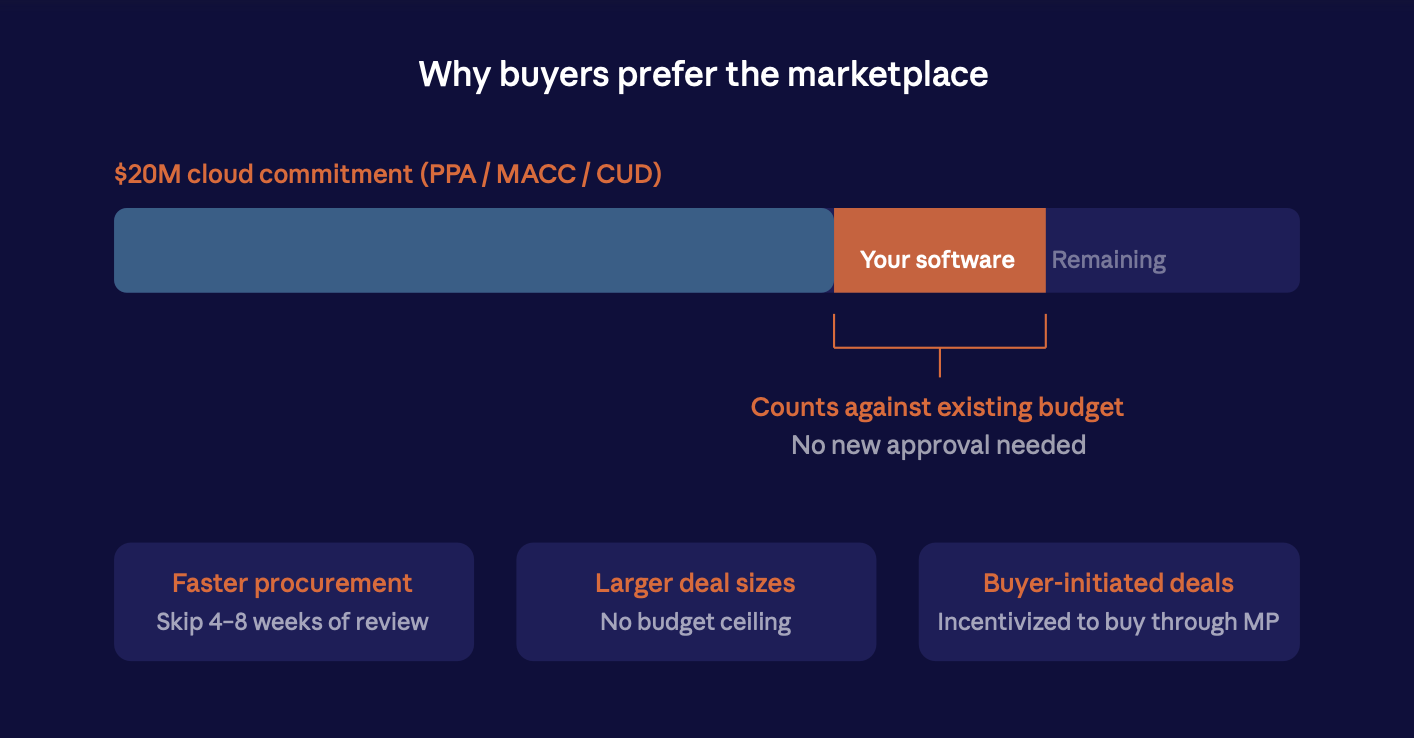
Cloud GTM matters because it gives ISVs (independent software vendors) access to faster procurement, larger deals, and net-new pipeline through cloud provider partnerships. As enterprise buyers consolidate software purchasing through their cloud providers, the companies selling through those marketplaces are capturing revenue that traditional direct sales motions cannot reach.
Pipeline: Co-selling with cloud provider reps gives ISVs access to accounts and budgets that traditional sales cannot reach. Cloud reps are incentivized to help customers consume their committed spend, which means they actively surface opportunities for third-party software. AWS alone reports over 3 million active marketplace subscriptions.
Deal velocity: Committed spend programs (PPA, MACC, CUDs) change the approval process. When a buyer's software purchase counts against the budget they've already committed to a cloud provider, it no longer competes with other line items for new funding. That single change removes the most common stall point in enterprise procurement.
Deal size: Marketplace deals tend to be larger because committed spend removes the budget ceiling that limits traditional contracts. Buyers can structure multi-year or consumption-based agreements using funds that are already allocated, which makes larger commitments easier to approve internally. Canalys reported $16B in enterprise software sold through hyperscaler marketplaces in 2023, growing at 84% year over year, and the trajectory has only steepened since.
The B2B software market exceeded $974B in 2023, and cloud marketplaces are the fastest-growing distribution channel in enterprise software.
How is Cloud GTM different from traditional GTM?
Traditional GTM runs through direct sales, custom contracts, and net-new budget approvals. Cloud GTM runs through marketplace infrastructure, standardized terms, and buyers' existing cloud commitments.
| Traditional GTM | Cloud GTM | |
|---|---|---|
| Sales channel | Direct sales, resellers, standard marketing | Cloud marketplaces and co-selling with cloud providers |
| Buyer's budget | New budget approval for each purchase | Buyer draws down pre-committed cloud spend |
| Procurement | Vendor onboarding, security review, legal cycles | Reduced or eliminated through marketplace pre-approval |
| Contracting | Custom service agreements, scope of work, order forms | Standardized EULAs or private offer terms |
| Co-sell | No cloud partner involvement | Cloud provider reps co-sell to accelerate deals |
| Billing & finance | Seller invoices and collects | Cloud provider invoices, collects, and disburses |
The difference that matters most operationally: in traditional GTM, every new vendor requires its own procurement cycle. In Cloud GTM, the buyer's existing cloud agreement covers the transaction, which is why marketplace-assisted deals routinely skip 4-8 weeks of legal and finance review.
How Cloud GTM actually works
A Cloud GTM deal moves through four stages: finding buyers with committed cloud budget, structuring the deal through the marketplace, co-selling with cloud provider reps, and managing fulfillment, billing, and expansion.
Find buyers with cloud budget
Enterprises pre-commit budgets to cloud providers through spend commitment programs. Software purchases made through the marketplace count against these commitments, which changes buyer motivation entirely.
- AWS PPA (Private Pricing Agreement) — enterprise commit to minimum annual AWS spend in exchange for discounted pricing
- Azure MACC (Microsoft Azure Consumption Commitment) — contractual agreement to spend a specific amount on Azure over a defined period
- GCP CUDs (Committed Use Discounts) — discounted pricing in exchange for committing to a minimum spend or resource level for 1-3 years
A company with $20M committed to AWS has a financial incentive to buy software through AWS Marketplace because it burns down spend they've already budgeted. Identifying which accounts carry active commitments is the first step in prioritizing Cloud GTM pipeline.
Common signals for finding these buyers:
- Co-sell conversations with cloud provider reps
- Account mapping exercises between ISV and cloud sales teams
- Buyer-provided procurement preferences during the sales cycle
- Cloud buyer intent data from Cloud GTM platforms
Structure the deal
Cloud marketplaces support three transaction paths:
- Public listing — discoverable and purchasable by any marketplace buyer
- Private offer — custom-priced deal created for a specific buyer with negotiated terms
- Channel Partner Private Offer (CPPO) — a reseller transacts on behalf of the buyer and owns the billing relationship
Most ISVs start with private offers for enterprise deals and layer in public listings and CPPOs as the motion matures. Each path serves a different buyer motion and deal structure.
Co-sell with cloud providers
Co-selling is the motion where ISVs and cloud provider field reps work together to identify, support, and close deals. Each hyperscaler runs its own co-sell program:
- AWS: ACE (APN Customer Engagements)
- Microsoft: Partner Center
- GCP: Google Cloud Partner Network (formerly Partner Advantage)
The process:
- ISV registers an opportunity in the relevant co-sell system
- Cloud rep validates the opportunity and attaches to the deal
- Cloud rep provides buyer introductions, account intelligence, and procurement support
- Deal closes through the marketplace, and the cloud rep gets credit toward their quota
Cloud reps carry quota tied to their customers' cloud consumption, so they are financially motivated to support purchases that burn down committed spend. Co-sell requires regular account mapping, shared pipeline visibility, and consistent follow-up. ISVs that run structured win-wire programs (sharing closed deal outcomes back to cloud reps) get pulled into more deals as a result.
Fulfill, bill, and expand
Fulfillment. Buyer is provisioned into the product, typically automated through marketplace APIs that trigger account creation on offer acceptance.
Billing and metering. For usage-based products, consumption is tracked and reported to the marketplace for invoicing. For flat-rate contracts, the cloud provider handles billing automatically.
Disbursement. Cloud provider collects payment and disburses revenue to the ISV, minus a transaction fee (typically 2-3%, varies by program tier, deal type, and partner status).
Renewals and expansion. Marketplace customers are renewed or expanded through new private offers. The same committed spend dynamics apply, making expansion a lower-friction path than renegotiating direct contracts.
How to build a Cloud GTM motion
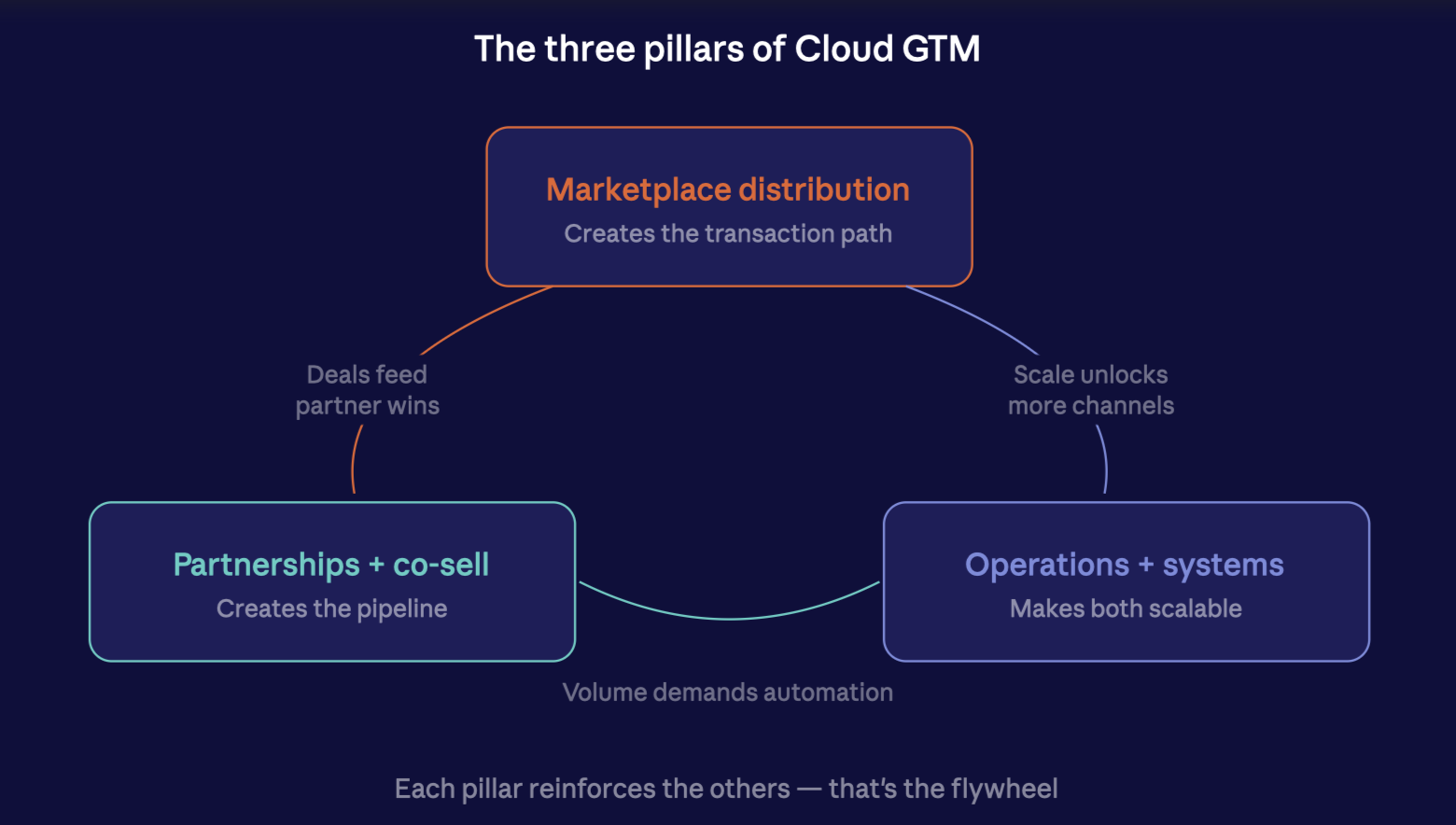
Building a Cloud GTM motion means making specific decisions across three pillars: listing on and transacting through cloud marketplaces, partnerships and co-sell with cloud providers, and the operational systems that make both repeatable.
Selling through cloud marketplaces
Selling on cloud marketplaces starts with defining your Cloud GTM Ideal Customer Profile (ICP). The most valuable accounts for marketplace selling share specific traits:
- Active committed spend (PPA, MACC, CUDs)
- Teams already purchasing software through marketplaces
- Procurement processes that favor pre-approved cloud channels
- High cloud consumption on a specific provider
ICP determines marketplace selection. If 70% of your buyer base runs on AWS, AWS Marketplace is the starting point. Other factors include cloud provider field coverage in your target verticals, partner program maturity (AWS ISV Accelerate vs. Azure IP Co-Sell vs. the Google Cloud Partner Network), and where competitive gaps exist in marketplace categories.
Once you have defined your ICP, pricing decisions follow:
- Offer structure — usage-based (consumption metered through the marketplace), committed contracts (flat-rate annual or multi-year), or hybrid
- Public vs. private — public listings drive inbound discovery. Private offers close enterprise revenue. Most marketplace ARR flows through private offers.
- Fee absorption — cloud providers charge certain transaction fees. Whether you absorb, adjust list pricing, or treat it as distribution cost affects margin and deal velocity.
Products with clear marketplace SKUs and pre-approved discount thresholds generate less friction in co-sell conversations, which connects distribution directly to the next pillar.
Partnerships and co-sell
Building a winning co-sell program can make your Cloud GTM strategy highly effective. Some best practices that we've seen:
- Partner program enrollment — each cloud marketplace has eligibility requirements before co-sell engagement is available. These are tied to technical readiness, listing status, and deal history.
- Account mapping — compare your target accounts against cloud provider customer bases. Prioritize overlap where accounts have large committed spend and active cloud field coverage.
- The "better together" narrative — cloud reps need collateral that positions your solution as a complement to the cloud platform: what workload problem it solves, what cloud consumption it drives, and what joint outcomes customers have achieved.
- Field engagement rhythm — shared pipeline reviews, regular updates with cloud reps, and win-wire programs that communicate closed deal outcomes. Consistent engagement turns one-off co-sell into a repeatable pipeline channel.
- Co-marketing — co-marketing campaigns with cloud providers, marketplace-specific landing pages, and enablement content for cloud reps. Marketing supports co-sell by generating partner-led demand and equipping cloud field teams to position your product.
Operations, systems, and workflows
The operational layer makes your Cloud GTM strategy measurable and scalable.
- CRM to co-sell sync — deal registration, opportunity status, and attribution flowing between Salesforce/HubSpot and ACE/Partner Center/PSC without manual re-entry
- Private offer workflows — approval routing, deal desk involvement, and pricing governance that scales as offer volume increases. This is the first operational process that breaks when Cloud GTM grows.
- Finance and revenue operations — marketplace disbursement tracking, revenue recognition for marketplace deals, and reconciliation between cloud provider payouts and internal records
- Reporting and analytics — unified view of marketplace ARR contribution, private offer conversion rates, co-sell win rates, and pipeline sourced through cloud partnerships
The three pillars reinforce each other. Distribution creates a transaction path. Partnerships create pipeline. Operations make both scalable.
How to measure Cloud GTM success
The metrics that matter most for measuring Cloud GTM success: marketplace converted pipeline, average deal size, offer velocity, co-sell win rate, revenue by cloud, and financial operations health. These six tell you whether the marketplace channel is growing, how fast deals are moving, and whether your partnerships are producing.
Marketplace pipeline and revenue: Track converted pipeline (total deal value of accepted marketplace offers) by quarter and year. Measure marketplace Annual Recurring Revenue (ARR) as a percentage of total ARR to gauge channel maturity. Early-stage Cloud GTM programs typically see 5-10% of revenue through the marketplace. Mature programs reach 20-30%+.
Average deal size. Marketplace ACV compared to direct deal ACV, tracked across periods (current quarter, current year, trailing 12 months). Marketplace deals tied to committed spend tend to produce larger contracts. Rising ACV over time signals that your pricing and packaging are working for cloud buyers.
Offer velocity:
- Private offer acceptance time — typically there are days between offer creation and buyer acceptance — a typical range is 3-7 days. Shorter acceptance times signal clean offer structure and smooth buyer approval.
- Private offer volume — total offers accepted per period and a leading indicator of channel growth. Track this volume alongside converted pipeline to confirm volume is scaling with revenue.
Co-sell win rate and engagement: These metrics live in cloud provider co-sell systems (ACE, Partner Center, PSC) and measure partnership strength:
- Co-sell win rate — close rate on deals with cloud rep involvement. The strongest proof point for co-sell ROI when presenting to leadership.
- Co-sell engagement volume — opportunities registered in co-sell systems per quarter. Shows whether your team is consistently feeding the co-sell pipeline.
- Inbound vs. outbound ratio — share of co-sell opportunities that cloud reps bring to you vs. you registering with them. A rising inbound ratio signals growing partner confidence.
Revenue by cloud: Converted pipeline split by AWS, Azure, and GCP. Shows which marketplace is producing and where to invest more co-sell effort, marketing, and operational resources. This is essential as you expand from single-cloud to multi-cloud.
Financial health: The metrics finance teams track:
- Disbursement status — whether cloud provider payouts are arriving on schedule, and reconciliation time against internal records
- Contracts approaching renewal — marketplace contracts expiring in the current month or quarter. Renewal visibility creates expansion opportunities and protects existing revenue.
- Marketplace fee tracking — transaction fees (2-3%) across your portfolio, monitored as a cost of distribution against the deal velocity and size benefits
Measure these quarterly at minimum. Individual numbers provide useful context, but quarter-over-quarter trajectory is what tells you whether the Cloud GTM motion is scaling.
What teams are involved in Cloud GTM?
Cloud GTM is a cross-functional motion. Partnerships and alliances typically lead the strategy, but execution spans sales, RevOps, finance, engineering, and marketing. The most common failure is treating Cloud GTM as a partnerships-only initiative without operational buy-in from the rest of the org.
| Team | Role | Key people | What they own |
|---|---|---|---|
| Executive Leadership | Approves | C-Suite | Budget and headcount for Cloud GTM, marketplace revenue targets, comp policy decisions, treating Cloud GTM as a core revenue channel |
| Partnerships & Alliances | Owns | VP/Head of Alliances, Cloud Alliance Managers, Partner Development Managers | Cloud provider relationships, co-sell strategy, partner program enrollment (ISV Accelerate, Azure IP Co-Sell, Google Cloud Partner Network), account mapping, field engagement |
| Sales | Executes | VP Sales, Account Executives, Sales Engineers | Running marketplace deals, co-selling with cloud reps, identifying buyer committed spend during discovery, coaching teams to sell through cloud channels |
| RevOps / Sales Ops | Operationalizes | RevOps Managers, Sales Ops Leads, Deal Desk | CRM integration with co-sell systems (ACE, Partner Center, PSC), deal registration accuracy, private offer approval workflows, account mapping data, influence attribution |
| Finance | Governs | CFO, Controller, Finance Ops | Pricing governance, discount thresholds, private offer policies, marketplace fee modeling, revenue recognition, disbursement reconciliation |
| Product & Engineering | Builds | Engineering Leads, Product Managers, Integration Engineers | Marketplace technical integrations, listing requirements, metering infrastructure, API provisioning, fulfillment automation |
| Marketing | Enables | Partner Marketing Manager, Product Marketing, Demand Gen | Marketplace listing content, "better together" narrative, co-marketing campaigns with cloud providers, sales enablement for cloud reps, marketplace demand programs |
As the channel matures, many companies add dedicated Cloud GTM roles: cloud alliance managers focused on a single hyperscaler, partner marketing specialists running marketplace demand programs, and marketplace operations leads managing offer workflows and finance reconciliation full-time.
How long does it take to build a Cloud GTM motion?
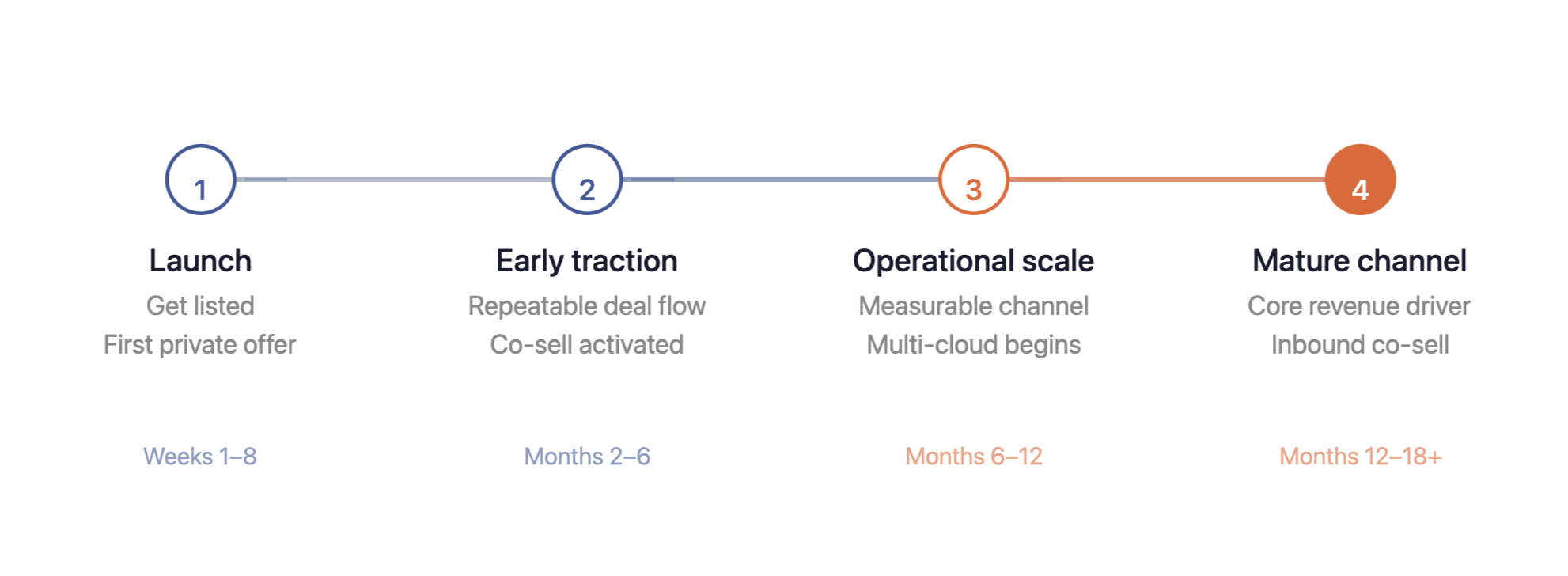
Most SaaS companies can get a marketplace listing live in 5–10 business days once it is submitted — the variable is the marketplace review queue, not the work on your side. Building a fully operational Cloud GTM motion with co-sell, private offer workflows, and repeatable revenue takes 6-18 months depending on internal readiness and the number of marketplaces involved. The timeline breaks into four maturity stages.
Stage 1: Launch (weeks 1-8)
Get listed and close your first marketplace deal.
- Select your first marketplace based on customer cloud spend concentration
- Define which SKUs will be public vs. private, and how they map to usage dimensions or commitment levels
- Complete legal and compliance groundwork: T&Cs, security documentation, tax configuration, refund policies. This is the most common source of listing delays.
- Build technical integration and submit your listing to the cloud provider
- Enroll in the cloud provider's partner program
- Close your first private offer to validate the transaction workflow
Companies using a Cloud GTM platform often compress this stage to 2-4 weeks. The output is a live listing, a defined SKU structure, and proof that the transaction path works.
Stage 2: Early traction (months 2-6)
Build repeatable deal flow and activate co-sell.
- Route existing customer renewals through the marketplace. This builds transaction volume, trains your team on private offer workflows, and establishes marketplace revenue history with cloud providers, all without depending on net-new pipeline.
- Register your first co-sell opportunities in ACE, Partner Center, or PSC
- Run initial account mapping with cloud provider field reps
- Establish private offer approval workflows (deal desk, finance, legal sign-off)
- Connect your CRM to marketplace and co-sell systems
- Build co-sell enablement content (solution briefs, "better together" narrative)
- Close 5-15 marketplace deals (a mix of renewals and new business) to establish pattern and internal confidence
By the end of this stage, your team should have a working co-sell relationship with at least one cloud provider rep team and a private offer workflow that runs through your CRM.
Stage 3: Operational scale (months 6-12)
At this stage, Cloud GTM becomes a measurable revenue channel.
- Private offer volume increases and approval workflows need to handle scale
- Co-sell becomes a consistent pipeline source with regular account mapping cadences
- Finance defines revenue recognition policy for marketplace deals, including how disbursement timing, fee netting, and multi-year contract structures differ from direct sales
- Marketing launches co-marketing campaigns and marketplace demand programs
- Reporting covers marketplace ARR contribution, co-sell win rate, and offer velocity
- Second marketplace launch begins (if applicable)
Companies at this stage typically see marketplaces contributing 10-15% of new business pipeline. This is also the point where manual processes start to strain and companies evaluate Cloud GTM platforms.
Stage 4: Mature channel (months 12-18+)
Cloud GTM operates as a core revenue channel with the same operational rigor as direct sales.
- Marketplace revenue reaches 20-30%+ of total ARR
- Multi-cloud presence across AWS, Azure, and GCP
- Co-sell generates inbound opportunities from cloud provider reps
- Renewals and expansion run through marketplace
- Finance has clean revenue recognition and automated disbursement reconciliation
- Dedicated Cloud GTM roles exist (cloud alliance managers, marketplace operations, partner marketing)
The timeline compresses when companies invest in Cloud GTM operations early: CRM integration, offer workflow automation, and co-sell data sync. Companies that try to scale manually through Stages 2 and 3 often need to retrofit tooling before reaching Stage 4.
What are the biggest challenges in Cloud GTM?
The biggest Cloud GTM challenges map to specific stages of maturity: listing speed during launch, offer workflow efficiency during early traction, co-sell data integrity at scale, marketplace revenue reconciliation, and multi-cloud operational management. Teams that recognize these early and invest in the right Cloud GTM infrastructure, whether through a platform like Suger or structured internal processes, are best positioned to move through each stage without stalling.
Listing takes longer than expected
Getting listed on a cloud marketplace involves technical integration, legal and compliance preparation, SKU definition, tax configuration, and cloud provider review cycles. Without a structured process, companies regularly spend 6-12 months getting their first listing live. Provider-specific requirements, compliance back-and-forth, and internal alignment across engineering, legal, and finance are what consume the timeline.
What to do:
- Map provider-specific listing requirements before you start building
- Prepare legal groundwork (T&Cs, security documentation, tax configuration) in parallel with technical integration
- Companies that work with a Cloud GTM platform typically get a submitted listing live in 5–10 business days
Private offers run on email and spreadsheets
The first few deals close through manual effort. Someone logs into the marketplace console, builds the offer, emails the buyer, waits for acceptance, updates the CRM. At 15-20+ offers per month, approvals get lost, offers expire before buyers accept, and the team creating offers becomes a bottleneck.
What to do:
- Build approval workflows with clear routing (deal desk, finance, legal)
- Set pre-approved pricing thresholds so standard deals move without manual sign-off
- Connect offer creation to your CRM so reps work from one system
Co-sell data fragments across systems
Opportunities registered in ACE, Partner Center, or PSC are disconnected from your CRM. Attribution becomes unreliable. Leadership can't answer how much pipeline is partner-sourced vs. partner-influenced.
What to do:
- Integrate co-sell systems with your CRM so deal registration and status sync automatically
- Define attribution rules for partner-sourced vs. partner-influenced before volume makes it hard to classify retroactively
- Run regular data audits to catch sync gaps early
Finance can't reconcile marketplace revenue
Each marketplace has different disbursement timing, fee structures, and reporting formats. Revenue recognition for marketplace deals requires its own policy because the mechanics differ from direct sales.
What to do:
- Define rev rec policy for marketplace transactions before deal volume makes it urgent
- Set up disbursement tracking that maps cloud provider payouts to internal records
- Involve finance in Cloud GTM planning from the start
Multi-cloud multiplies everything
Each additional marketplace adds a separate console, co-sell system, reporting stream, and disbursement process. The operational model built for one cloud needs to scale across two or three.
What to do:
- Treat second marketplace launch as process replication, not a net-new build
- Centralize reporting and offer management across clouds before adding the third
- Evaluate whether current tooling supports multi-cloud, or whether a unified platform is the right investment
What is a Cloud GTM platform?
A Cloud GTM platform is software that helps ISVs manage the operational side of selling through cloud marketplaces. It connects listings, private offers, co-sell workflows, billing, and reporting into a single system instead of requiring teams to work across separate marketplace consoles, co-sell portals, and internal tools.
Core capabilities of a Cloud GTM platform:
- Listing management — publish and maintain product listings across AWS, Azure, and GCP from one place
- Private offer workflows — create, route, approve, and track offers without switching between marketplace consoles and CRM
- Co-sell automation — sync opportunities between your CRM and cloud provider co-sell systems (ACE, Partner Center, PSC)
- Billing and metering — track usage, manage disbursements, and reconcile marketplace revenue
- Analytics and reporting — unified view of marketplace pipeline, deal velocity, co-sell performance, and revenue by cloud
What are the benefits of a Cloud GTM platform?
The benefit of having a Cloud GTM platform is replacing the combination of marketplace console logins, spreadsheets, email-based approvals, and manual CRM updates that most companies start with — and that cause operational gaps, manual delays, and issues with financial reporting. In addition to the automation of busy work, purchasing a Cloud GTM solution from an AWS, Microsoft, or Google approved vendor (like Suger) can make ISVs eligible for exclusive credits that they would not have access to if they try to build the cloud marketplace integrations themselves.
When do you need a Cloud GTM platform?
A Cloud GTM platform becomes necessary when the operational complexity of marketplace selling outgrows what manual workflows can handle. Most ISVs look at these six signals to indicate it's time:
Your listing requires engineering resources: Building and maintaining direct integrations with cloud marketplace APIs takes engineering time. Each marketplace has its own technical requirements, and keeping integrations current as APIs evolve means ongoing maintenance. A Cloud GTM platform provides pre-built, API-first marketplace connections that require zero engineering, freeing your team to focus on product development.
Private offer volume is increasing: When your team is creating 15-20+ private offers per month, manual offer creation through marketplace consoles becomes a bottleneck. Offers take longer to build, approvals stall in email threads, and pricing errors start to surface. A platform with offer workflow automation eliminates these friction points.
Co-sell motion is scaling: Once co-sell opportunities are flowing through ACE, Partner Center, or PSC, keeping that data in sync with your CRM becomes critical. A platform that connects co-sell systems to your CRM automatically ensures attribution stays accurate and leadership has a reliable view of partner-influenced pipeline.
Finance is spending hours on reconciliation: Each cloud provider has different disbursement timing, fee structures, and reporting formats. If your finance team is manually mapping marketplace payouts to internal records, that workload grows with every new deal. A platform that automates disbursement tracking and integrates with your finance systems gives finance clean data without manual effort.
You're launching on a second marketplace: Running one marketplace manually is manageable. Adding a second means a separate console, separate co-sell system, separate reporting, and separate disbursement stream. A platform that centralizes multi-cloud operations keeps the second launch from doubling your operational overhead.
Marketplace deals have slow deal cycles: If reps prefer direct deals because marketplace workflows are slower or more confusing than their standard CRM process, the channel stalls. A platform that embeds marketplace deal execution into Salesforce or HubSpot makes marketplace deals feel like any other deal in the CRM. Reps sell through the path of least resistance.
If you're experiencing some of these, the operational cost of manual Cloud GTM is likely exceeding what a platform would cost — and you're losing out on potential revenue because of time spent doing the busy work.
What to look for in a Cloud GTM platform
The right Cloud GTM platform covers the full lifecycle of marketplace selling: listing, private offers, co-sell, billing, revenue operations, and analytics. These are the capabilities that matter most when evaluating options.
Marketplace coverage. How many cloud marketplaces does the platform support natively? AWS, Azure, and GCP are the baseline. Some platforms also support Snowflake, Alibaba, or other emerging marketplaces. Broader coverage matters as your buyer base spreads across clouds.
Private offer workflows. Can your team create, route, approve, and track private offers from within your CRM? CRM-native offer management is the single biggest factor in how fast your team can scale offer volume.
Co-sell automation. Does the platform sync opportunities between your CRM and cloud co-sell systems (ACE, Partner Center, PSC)? Bi-directional sync, automatic deal registration, and status updates are what make co-sell operational at scale.
Quote-to-cash coverage. Some platforms handle listing, offers, and co-sell. Fewer extend through CPQ integration, metering, billing, disbursement tracking, revenue recognition, and ERP sync. Evaluate how far into the post-transaction lifecycle each platform reaches.
CRM and finance integrations. Salesforce and HubSpot integration is the starting point. The deeper question is whether the platform connects to your finance stack: CPQ, billing systems (Stripe, Metronome, Chargebee), accounting software (NetSuite, QuickBooks), and data warehouses.
AI and workflow automation. Can the platform automate the full marketplace lifecycle so there are no operational gaps requiring manual intervention? Can it automate repetitive tasks like co-sell field population, offer creation from CRM data, deal routing, and renewal triggers? Does the platform ensure that all teams feel the data is trustworthy and reliable? The depth of both automation and AI support determines how much operational leverage you gain as volume increases.
If you are running a formal evaluation you have to defend, our Cloud GTM platform evaluation guide turns these dimensions into a scored rubric and shows how to source each answer from the vendor's own documentation.
Where Suger fits
Suger is built for full-lifecycle marketplace operations: listing, private offers, co-sell, CPQ, metering, billing, revenue reconciliation, and ERP sync in a single system. Whether that is the right shape for you depends on the dimensions above — a team that only needs to get listed is buying something different from a team reconciling marketplace revenue to an ERP.
Three capabilities to weigh against your own requirements:
- Quote-to-cash automation. Connects the deal flow from CPQ quote to marketplace offer to entitlement to revenue recognition, so finance gets revenue data without reconciling across systems.
- Usage metering and billing flexibility. Meters consumption across AWS, Azure, and GCP from a single interface, with data flowing directly into billing systems like Stripe, Metronome, Orb, and Chargebee. Teams can offer consumption pricing without building custom metering infrastructure.
- Multi-cloud coverage. Supports six marketplaces (AWS, Microsoft, Google Cloud, Snowflake, Alibaba Cloud, and Oracle). Listings, offers, co-sell, and reporting run from one system with 25+ native integrations.
300+ software companies use Suger, including Intel, Snowflake, Notion, Webflow, and Fivetran. Named customers report 3x growth in marketplace or co-sell volume (Fireblocks, Aikido Security). Marketplace deals also run larger than direct ones across the category — CrowdStrike measured 140% on AWS Marketplace.
Choosing the right platform that can support your business is mission critical. If you'd like to learn more about how Suger can support your Cloud GTM journey, schedule a demo or explore the platform.
How this guide was written
Scope. Everything stated about Suger is verifiable in the platform pages and product documentation. Customer outcomes name the customer and link to the write-up.
Limitations. Suger has not independently tested Tackle, Clazar, or Labra, and this guide does not rank them. Treat any capability comparison as a starting point for your own evaluation, not as verified fact, and confirm current capabilities with each vendor directly. Marketplace-wide figures (for example CrowdStrike's 140% contract-value benchmark) describe the category, not Suger's customer base.
Last verified August 6, 2026. Reviewed quarterly. Found something out of date or wrong? Email support@suger.io and we will correct it.
Primary sources
Cloud providers change these rules without notice. Where this guide describes a provider rule, check it against the provider's own documentation:
- AWS — Marketplace APIs behind listings, agreements, entitlements and metering: docs.aws.amazon.com/marketplace/latest/developerguide/about-apis.html
- Microsoft — Co-sell statuses, IP co-sell eligibility and MACC contribution: learn.microsoft.com/en-us/partner-center/referrals/co-sell-overview
- Google Cloud — Partner documentation and the Cloud Commerce Partner Procurement API: docs.cloud.google.com/marketplace/docs/partners
Links last confirmed live .
Frequently asked questions
What is Cloud GTM? +
Cloud GTM (Cloud Go-to-Market) is the strategy ISVs use to sell software through cloud provider marketplaces like AWS, Azure, and GCP. It covers listing, transacting, and co-selling with cloud providers to reach enterprise buyers and grow marketplace revenue.
How is Cloud GTM different from direct sales? +
Direct sales runs through your own contracts, billing, and procurement. Cloud GTM runs through marketplace infrastructure where the cloud provider handles invoicing, collection, and disbursement. Buyers purchase using pre-committed cloud spend, which compresses procurement timelines and removes budget approval friction.
What is committed spend in Cloud GTM? +
Committed spend refers to budget enterprises pre-commit to cloud providers. AWS calls it PPA (Private Pricing Agreement), Azure calls it MACC (Microsoft Azure Consumption Commitment), and GCP calls it CUDs (Committed Use Discounts). Software purchased through marketplaces counts against these commitments, which is why buyers prefer marketplace procurement.
How does co-sell work in Cloud GTM? +
ISVs register opportunities in cloud provider co-sell systems: ACE on AWS, Partner Center on Azure, PSC on Google Cloud. Cloud reps attach to deals, provide buyer introductions, and support procurement. They are incentivized to help because marketplace purchases burn down their customers' committed spend.
What is a CPPO in Cloud GTM? +
A CPPO (Channel Partner Private Offer) is a marketplace transaction where a reseller transacts on behalf of the buyer. The ISV extends a margin to the partner, and the partner owns billing. AWS, Azure, and GCP each have CPPO programs. Common in enterprise deals with existing channel relationships.
How long does Cloud GTM take to launch? +
With a Cloud GTM platform, a submitted listing typically goes live in 5–10 business days — the variable is the marketplace review queue, not your team. Without one, 6-12 months is common once technical integration, legal preparation, and cloud provider review cycles are added up. Early co-sell traction and initial deals usually follow within 2-6 months of listing.
What is a private offer in Cloud GTM? +
A private offer is a custom marketplace deal created for a specific buyer with negotiated pricing, terms, and contract length. The buyer accepts through the marketplace, and the cloud provider handles billing. Private offers are how the majority of enterprise Cloud GTM revenue is transacted.
How should reps be compensated on marketplace deals? +
Comp neutrality is the recommended approach: reps earn the same commission on marketplace deals as direct deals. Cloud providers charge 2-3% transaction fees. If that reduces rep comp, sellers avoid marketplace. Companies that maintain comp neutrality see faster Cloud GTM adoption across sales teams.
Is Cloud GTM worth it for early-stage companies? +
Yes. ISVs with enterprise buyers on AWS, Azure, or GCP benefit from simplified procurement and access to committed spend budgets at any deal size. Cloud provider partner programs (ISV Accelerate, Azure IP Co-Sell, Google Cloud Partner Network) offer co-sell support and marketplace visibility that compounds over time.
Can I manage Cloud GTM without a platform? +
For the first 5-10 deals, manual processes work. Beyond that, private offer approvals, co-sell data sync, CRM integration, and finance reconciliation become time-consuming. Most ISVs evaluate a Cloud GTM platform once monthly offer volume exceeds 15-20 or they expand to a second marketplace.
What does a Cloud GTM team look like? +
Partnerships and alliances typically own the strategy. Sales executes marketplace deals and co-sell. RevOps manages CRM integration and deal workflows. Finance handles revenue recognition and disbursement tracking. Engineering maintains marketplace integrations. Marketing supports co-sell enablement and co-marketing with cloud providers.
What KPIs should I track for Cloud GTM? +
The most important are: marketplace ARR as a percentage of total revenue, marketplace deal velocity vs. direct, co-sell win rate, private offer acceptance time, and revenue split by cloud. Track quarterly. The trajectory matters more than any single data point.
Which Cloud GTM platforms should I evaluate? +
The platforms most often shortlisted are Suger, Tackle, Clazar, and Labra. Suger covers the lifecycle from listing through revenue reconciliation across six marketplaces — see the platform pages for what that includes. Suger has not independently tested the others, so check each vendor's own documentation for current capabilities rather than relying on a competitor's summary.
What results do companies see from Cloud GTM? +
ISVs that invest in Cloud GTM operations report faster deal cycles, larger contract values, and net-new pipeline from co-sell. Named Suger customers report 3x growth in marketplace or co-sell volume — Fireblocks, Aikido Security, and Securiti AI. Separately, CrowdStrike measured marketplace transactions running 140% larger than direct deals on AWS Marketplace; that is a marketplace-wide benchmark, not a Suger customer result.
Published · Last reviewed
Written and maintained by the Suger team.
Spotted something out of date? Email support@suger.io and we will correct it.