
What is Google Cloud Marketplace?
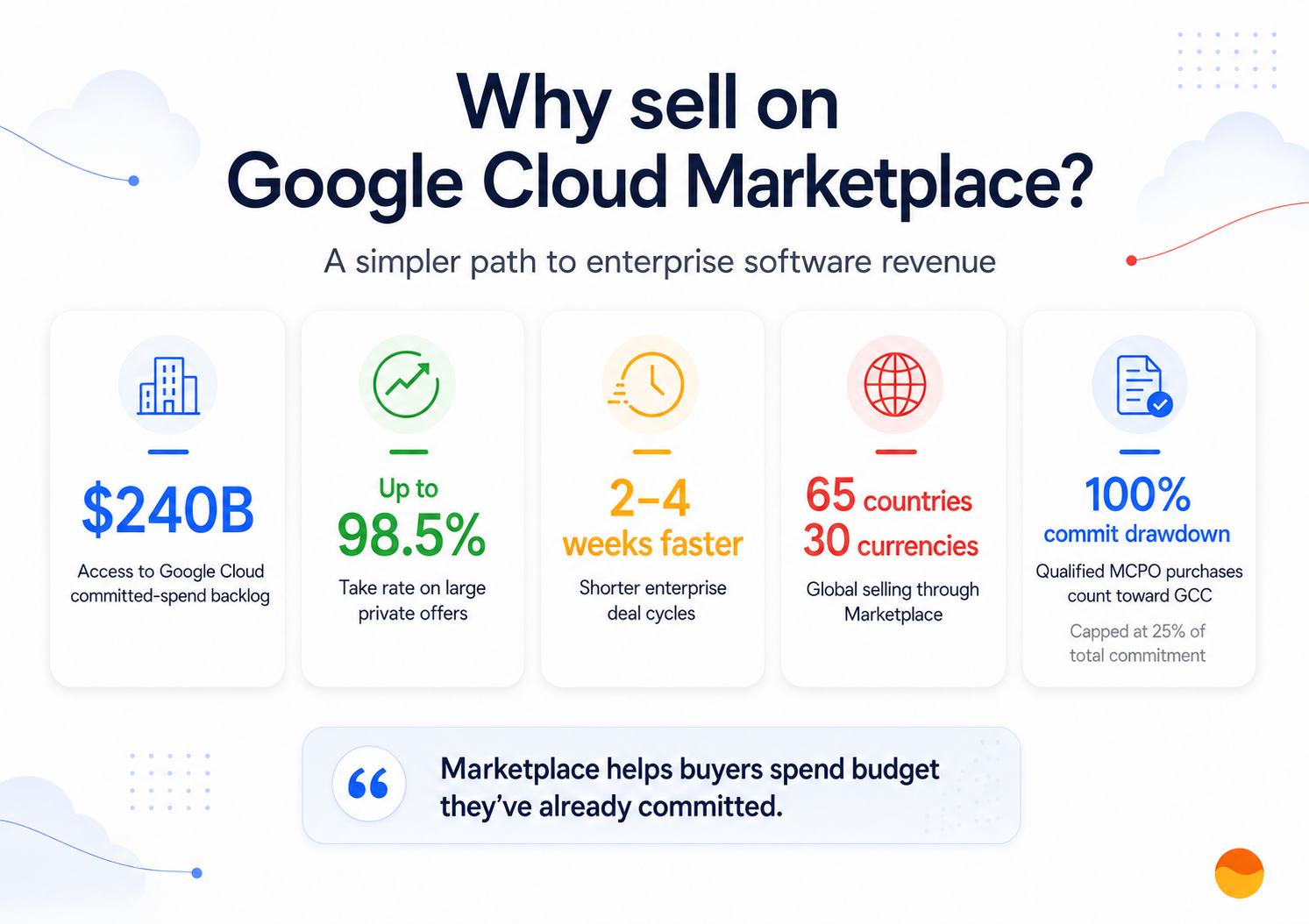
Google Cloud Marketplace is a digital storefront where software companies list products and Google Cloud customers buy them using their existing Google Cloud billing relationship. It spans thousands of partner listings across 65 countries and 30 currencies, and was named a Leader in IDC's November 2025 Worldwide Hyperscaler Marketplaces MarketScape.
What are the benefits of selling on Google Cloud Marketplace?
Four things ISVs cannot replicate on their own:
- Access to a $240B Google Cloud committed-spend backlog
- The highest take rate of any major cloud marketplace — up to 98.5% of TCV on large private offers
- A dedicated commercial channel for AI agents through Gemini Enterprise
- A co-sell motion where Google field reps earn quota credit and SPIFFs on closed Marketplace deals
Enterprise software sales through cloud marketplaces hit roughly $30 billion in 2024. Omdia's October 2025 forecast projects $163 billion by 2030 at a 29.1% CAGR, with agentic AI alone driving an estimated $24.4 billion of that. Across the Big 3 Hyperscalers (AWS, Microsoft, and Google), enterprises now hold close to $470 billion in committed cloud spend — and a fast-growing share flows through marketplace procurement.
Procurement teams are consolidating vendor purchases through cloud providers they already pay. If your software is on Google Cloud Marketplace, it becomes part of a budget that's already approved. If it's not, you're competing for a separate line item that has to clear vendor onboarding, legal review, and procurement committee from scratch.
Does buying on Google Cloud Marketplace count toward committed spend?
Yes — and this is the single biggest reason Marketplace is exploding. Enterprises sign multi-year Google Cloud Committed Spend (GCC) agreements, often $10M to $1B+, in exchange for discounts. If they don't consume the commitment, they lose negotiating leverage at renewal or forfeit credits outright.
Marketplace purchases count against GCC. As of June 9, 2025, qualifying Marketplace Channel Private Offer (MCPO) transactions deliver 100% commit drawdown tied to the final negotiated price, capped at 25% of the total commitment.
The sales conversation changes completely. You're no longer asking the buyer to find new budget. You're helping them spend budget they've already committed.
How long do Google Cloud Marketplace deals take to close?
Google Cloud Marketplace compresses enterprise procurement from months to weeks by eliminating new vendor onboarding, separate invoicing, and independent legal review. Per the Google-commissioned Futurum Group study Scaling Smarter (June 2025), 100% of ISVs surveyed said Marketplace shortens sales cycles, and high-performing partners report 2–4 weeks of cycle compression on enterprise deals.
What changes for the buyer:
- The existing Google Cloud billing relationship covers the transaction — no new vendor setup
- Private offer acceptance creates a binding agreement directly on the buyer's Google Cloud project
- Deals that take 3–4 months through traditional procurement can close in weeks
- Google field sales reps (FSRs) get quota credit on Marketplace third-party deals plus SPIFFs on closes — making co-sell a structural priority, not a favor
The same Futurum study found:
| Metric | Lift for Marketplace partners |
|---|---|
| Deal size | +112% |
| Multi-year deals | 70% of partners report more |
| Marketplace revenue growth in 2024 | 90% of partners (65% at high double-digit) |
| Customer retention | +14% |
Can I sell internationally on Google Cloud Marketplace?
Yes. Google Cloud handles multi-currency billing, localized tax compliance, and regional regulatory frameworks across 65 countries and 30 currencies. A 50-person SaaS company can sell into EMEA, APAC, and LATAM through Marketplace without building international billing, invoicing, or tax infrastructure — removing a barrier that would otherwise take months of legal and finance work plus regional entity setup.
What can you sell on Google Cloud Marketplace?
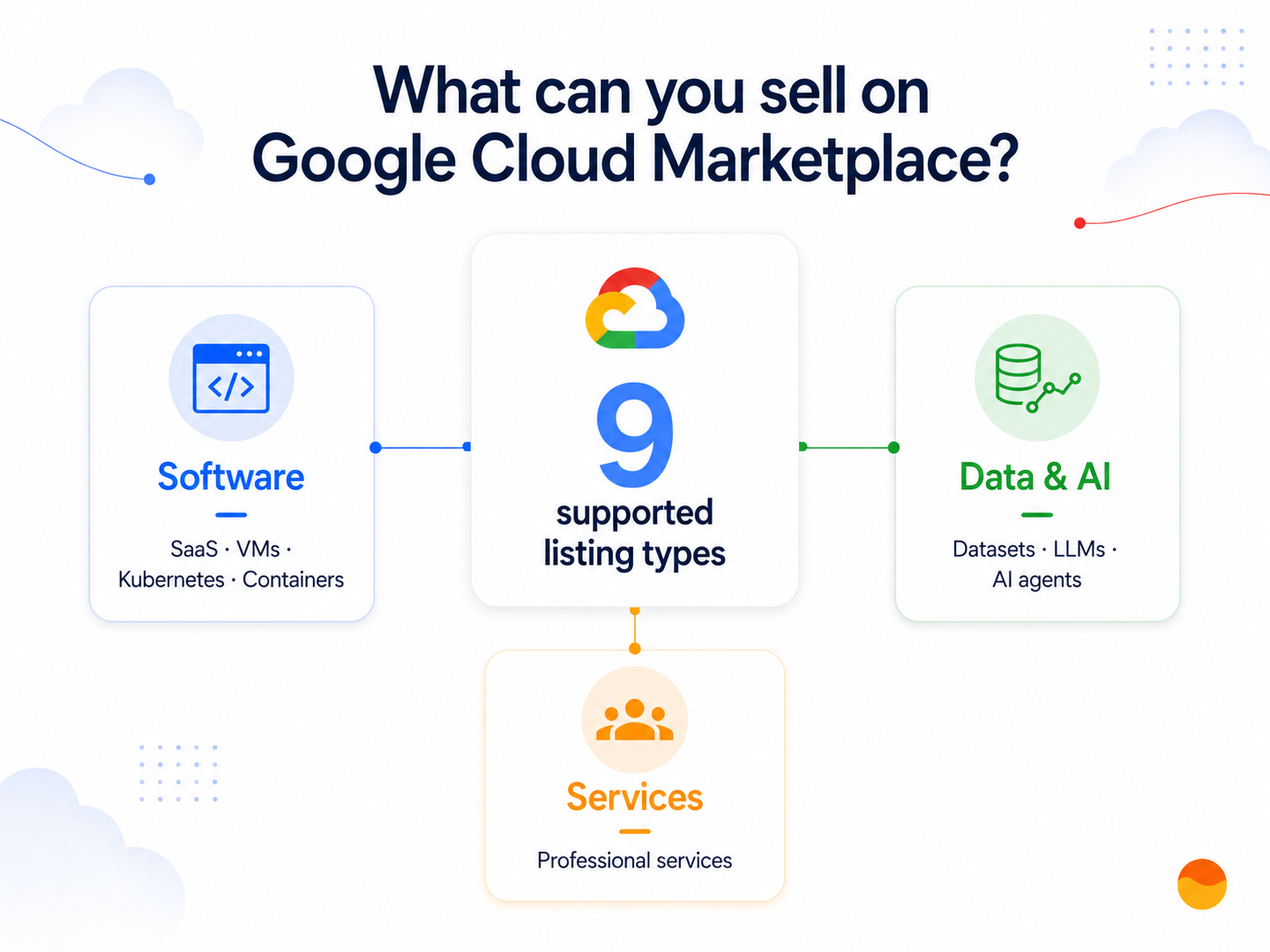
Google Cloud Marketplace supports nine commercial listing types. Your product type determines your integration path, available pricing models, and how downstream deal structures work.
What product types does Google Cloud Marketplace support?
| Product type | What it is | Best for |
|---|---|---|
| Integrated SaaS (Google-billed) | Vendor-operated SaaS where Google handles procurement, entitlements, and billing through the Cloud Commerce Partner Procurement API | Modern B2B SaaS; the default for new listings |
| VM products | Pre-configured Compute Engine images with deployment packages | Applications requiring customer-side compute |
| Kubernetes apps | Containerized apps for GKE and GKE Enterprise | Containerized workloads and microservices |
| Terraform Kubernetes apps | Helm-chart-based path through Artifact Registry | Standardized GKE/Helm deployments |
| Container images | Open-source containers via Artifact Registry / Container Registry | Developer-facing OSS tools |
| Datasets | BigQuery-hosted commercial data | Data vendors (Dun & Bradstreet, Equifax, Weather Source) |
| Professional services | Implementation, training, managed services, premium support | Service delivery; private-offer only, US-only at launch |
| Foundation models / LLMs | Models deployable to Vertex AI with provisioned throughput | Model providers (Anthropic, AI21) |
| AI agents (A2A protocol) | Agents that integrate with Gemini Enterprise via Agent Cards | Agentic AI products |
Standalone (non-integrated) SaaS listings are no longer accepted; existing standalone listings must convert to integrated billing within six months.
What are AI agents on Google Cloud Marketplace?
The AI Agent Marketplace launched at Google Cloud Next '25 (April 2025) as a dedicated category for agentic AI products. By Next '26 the catalog had grown to more than 70 partner-built agents from Accenture, Adobe, Deloitte, PwC, UiPath, and others. Agents listed with Agent Cards — JSON metadata files conforming to the A2A protocol — appear directly inside Gemini Enterprise's Agent Gallery, a distribution surface no other hyperscaler offers.
The A2A protocol moved to neutral governance under the Linux Foundation's Agentic AI Foundation in April 2026, with version 1.2 reported in production at more than 150 organizations including Google, Microsoft, AWS, Salesforce, SAP, and ServiceNow. Google announced a $750M partner innovation fund at Next '26 oriented toward agent builders.
For ISVs with an agentic AI component, this is the single largest 2025–2026 strategic opportunity on any cloud marketplace. The category went from launch to 70+ validated agents in twelve months. Buyer behavior, pricing norms, and validation friction are still being established — early movers can establish disproportionate visibility before the catalog gets crowded.
Does my product need to run on Google Cloud to list on Marketplace?
Yes — your product must be primarily hosted on Google Cloud. This is the single largest gating requirement. Google validates it through a Solution Validation Form review and accepts six documented architecture patterns, from "every component on GCP" to designs where the compute/data plane lives on Google Cloud while smaller control planes, agents, or migration sources sit elsewhere. The core scale, destination, or storage plane of your product must be on Google Cloud.
ISVs whose primary footprint is AWS Marketplace or Azure face a real architectural decision before they can list. Depending on product complexity, this can mean months of engineering work.
How much does selling on Google Cloud Marketplace cost?
Google charges a percentage-based revenue share on each Marketplace transaction, calculated on pre-tax total contract value. As of May 15, 2025, Google moved from a flat 3% fee to a variable structure that rewards larger deals — meaningfully more ISV-favorable than the AWS or Azure flat fees on equivalent deals.
What is the Google Cloud Marketplace revenue share?
| Deal type | Revenue share | ISV net |
|---|---|---|
| Standard public offers and private offers under $1M TCV | 3.0% | 97.0% |
| Private offers $1M – $10M TCV | 2.0% | 98.0% |
| Private offers $10M+ TCV | 1.5% | 98.5% |
| All renewals | 1.5% | 98.5% |
| Eligible channel shifts, migrations, native renewals | 1.5% | 98.5% |
| MCPO channel deals | No incremental fee to the ISV | — |
Three points worth internalizing:
- The rate is tiered per-deal, not vendor-wide. A $12M private offer is charged at 1.5%, even if the rest of your Marketplace revenue is at 3%.
- Renewals at 1.5% materially improve LTV math compared to the 3% net-new rate — a reason to price multi-year contracts and prepay structures aggressively.
- MCPO carries no incremental ISV fee — a meaningful structural advantage over AWS CPPO, which adds a 0.5% uplift.
What pricing models does Google Cloud Marketplace support?
| Model | Available for | How it works |
|---|---|---|
| Free | SaaS, VM, Kubernetes | Customer pays only underlying Google Cloud infrastructure |
| BYOL | VM, Kubernetes | Vendor sells the license outside Marketplace; Marketplace handles discovery and deployment |
| Subscription | SaaS | Flat monthly or annual fee, prorated for partial months |
| Usage-based (metered) | SaaS, VM, Kubernetes | Customer pays on measured consumption; SaaS requires Service Control usage reporting within one hour of generation |
| Combined (subscription + usage) | SaaS | Base subscription plus variable consumption fee |
| Private offer | All paid types | Custom pricing, terms, and payment schedules negotiated with a specific customer |
SaaS supports up to 24 pricing plans per product and up to eight metrics per usage-based plan. Once you publish a listing, pricing model changes are gated by a minimum 30-day window. Choose your model with downstream deal structures in mind — not just your current billing pattern.
How do Google Cloud Marketplace disbursements work?
Google bills the buyer, collects payment, and disburses to the seller on a monthly cycle. ISVs are paid on the 21st of the following month, with the underlying payment landing 45–60 days after the customer billing cycle. You never invoice Google directly — this eliminates late-payment risk but ties cash flow to Google's disbursement timeline.
What you need to know:
- Disbursements are calculated on aggregate monthly revenue across all Marketplace transactions
- ISV reports — charges, usage, disbursements, customer insights — are available in BigQuery
- A Postpay Credits column in the detailed disbursements report tracks commitment credits applied to private offers
- Reconciliation involves parsing disbursement files, matching transactions to internal records, and handling refunds and credits
At low deal volume, reconciliation is manageable in spreadsheets. At scale, it becomes a significant operational workload that finance teams underestimate at the planning stage. Cloud GTM platforms like Suger automate disbursement reconciliation, match Marketplace payouts to internal records, and feed clean data into your ERP and revenue stack.
How to list on Google Cloud Marketplace
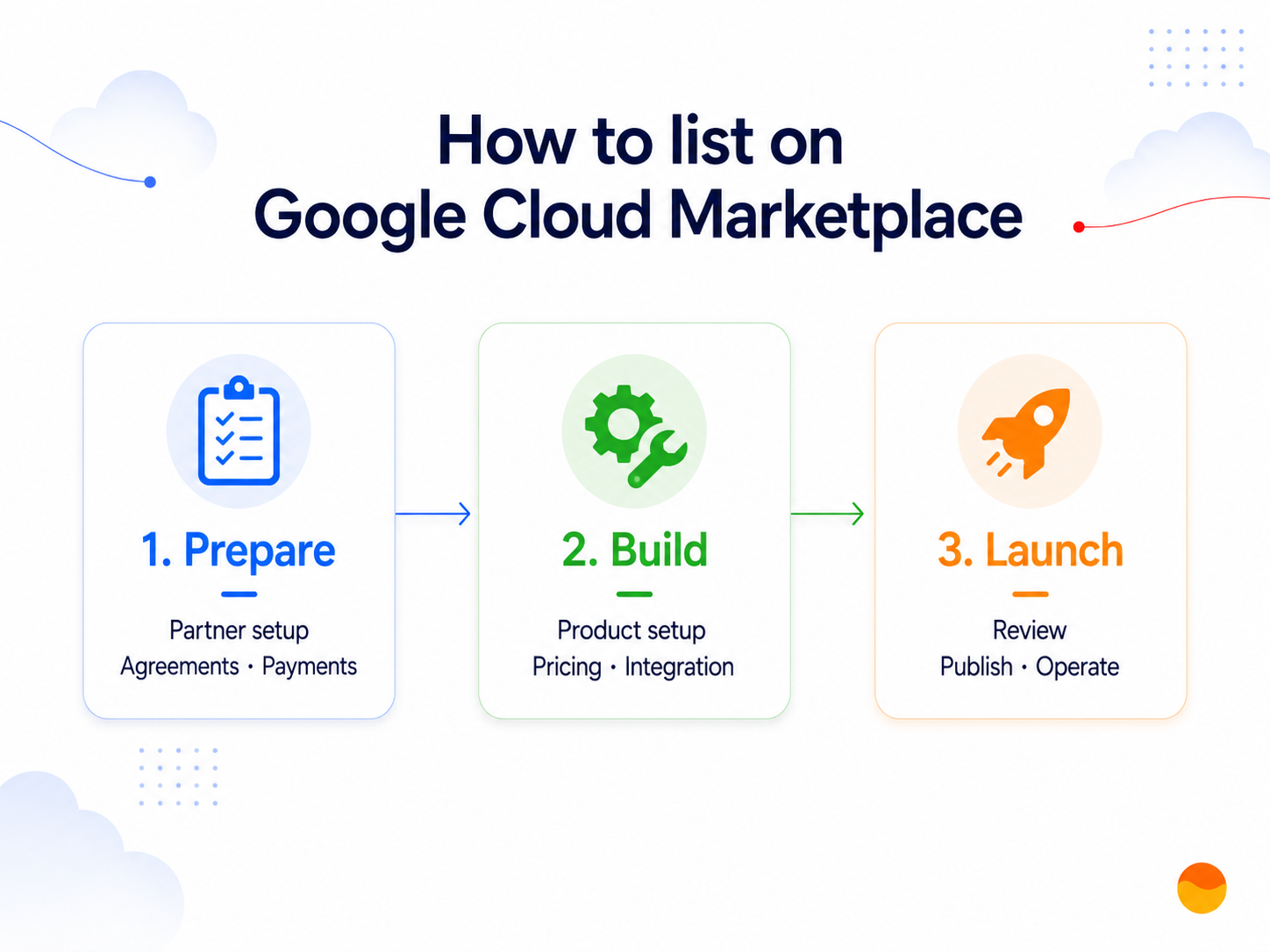
Listing runs through three phases over 8–16 weeks for a well-prepared product, longer if engineering bandwidth is constrained or architecture changes are needed to meet the primary-hosting requirement.
What are the requirements to sell on Google Cloud Marketplace?
To get listed on Google Cloud Marketplace, you need:
- Membership in good standing in the Google Cloud Partner Network (Build engagement model for ISVs)
- An accepted Marketplace Vendor Agreement, signed by a Partner Administrator in Partner Network Hub
- A legal entity incorporated in a Google-supported region
- A payment profile in good standing — the entity must match the MVA signatory and the address must sit in the country of incorporation
- A dedicated public Google Cloud project (recommended naming pattern: PARTNER_NAME-public)
- A production-ready, enterprise-ready product — no alpha or beta, no known vulnerabilities, with feature parity to off-Marketplace versions
- An architecture that passes the "primarily hosted on Google Cloud" test under one of six accepted patterns
The most common bottleneck is the legal-and-banking sequence. Many ISVs lose weeks because they start tax and banking setup after beginning listing work. Submit MVA, banking, and tax documentation in parallel with technical work — this stall point has no technical workaround.
How to list on Google Cloud Marketplace step-by-step
Google publishes stage-specific timing rather than a single end-to-end SLA. Pricing review takes up to four business days, some component reviews take up to two weeks, and VM products can go public within minutes once final approvals land. The realistic end-to-end timeline for a well-prepared SaaS ISV is 8–16 weeks.
Phase 1: Preparation and enrollment. Join the Google Cloud Partner Network and sign the Marketplace Vendor Agreement (1–4 weeks depending on document turnaround), then complete the Cloud Marketplace Project Info Form to unlock Producer Portal and API access. Configure your payment profile so the legal entity matches the MVA signatory and the address sits in the country of incorporation. Set up IAM roles for your build team — SaaS teams typically need Service Account Admin, while VM and Kubernetes teams need Compute Storage Admin.
Phase 2: Product, pricing, and integration. Submit your pricing model for review (up to four business days — start this early since it can run in parallel with technical work). Build the integration path for your product type: Cloud Commerce Partner Procurement API integration for SaaS (account creation, entitlement events, usage reporting via Service Control), deployment packaging for VM, or repo and chart packaging for Kubernetes apps. Complete the Solution Validation Form and pass architectural review (typically 2–4 weeks). Build the required co-branded landing page for SaaS listings.
Phase 3: Review, launch, and operate. Submit for final review across Product details, Pricing, and Technical integration. SaaS reviews cover end-to-end procurement flow; VM reviews include deploy/uninstall validation, unit tests, and image vulnerability scanning; Kubernetes apps are scanned with Artifact Analysis. Once approved, publish via Producer Portal. After launch, your Partner Engineer creates a public issue tracker for the product, and you begin operating against ongoing compliance and disbursement workflows.
Cloud GTM platforms like Suger compress what's typically a 6–8 week internal engineering effort into days by handling Procurement API integration, listing submission, and review cycles through pre-built connections.
What makes a Google Cloud Marketplace listing successful?
Listing quality matters for two reasons that compound.
Discoverability. Keywords in your title, description, and category metadata drive Marketplace search placement. "Cloud cost optimization for BigQuery workloads" outperforms "comprehensive platform for enterprises." Think about what an enterprise buyer would type into Marketplace search and work backward.
Field seller engagement. Google field reps evaluate your listing before deciding whether to bring you into a co-sell motion. A thin or generic listing reduces the likelihood they'll champion you. Architecture diagrams showing how your product integrates with Vertex AI, BigQuery, Looker, or Chronicle improve both buyer confidence and field engagement.
ISVs that actively update content, reflect new features and use cases, and optimize based on performance data see compounding returns. A Cloud GTM platform like Suger lets you manage and update listings across Google Cloud Marketplace as well as AWS and Microsoft from a single interface, so maintenance doesn't require logging into separate marketplace consoles.
What are the offer types on Google Cloud Marketplace?
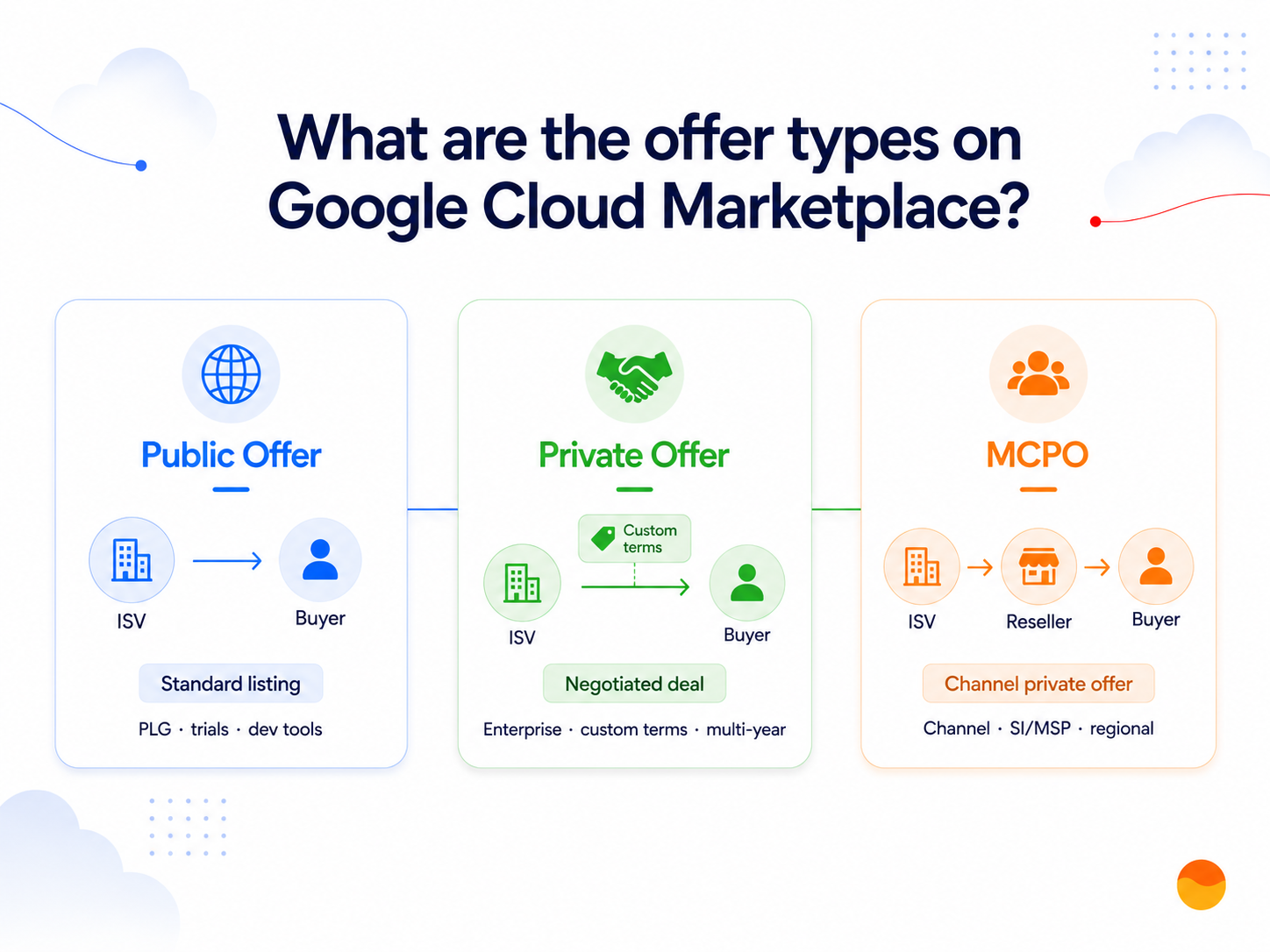
Google Cloud Marketplace transactions happen through three primary paths, namely Public Offers, Private Offers, and Marketplace Channel Private Offers (MCPO).
| Deal path | What it is | When to use it |
|---|---|---|
| Public offer | Default listing pricing, visible to any buyer | Self-service, PLG, low-friction SaaS, developer tools |
| Private offer | Customer-specific pricing, terms, and payment schedule | Enterprise deals, negotiated pricing, multi-year commitments |
| MCPO (channel private offer) | Channel partner extends a private offer to the customer; partner owns billing and revenue recognition | Reseller-led deals, SI bundles, regional coverage, deals where the partner holds the customer relationship |
What are public offers on Google Cloud Marketplace?
A public offer is the default listing: pricing, terms, and entitlements visible to any Google Cloud customer. The buyer experience is straightforward — review the listing, subscribe, deploy — and can happen in a single session, with Google handling billing through the customer's existing project.
Public offers work for product-led growth motions, free-trial conversion, and developer-facing tools. Most ISVs see >70% of revenue flow through private offers once they hit enterprise scale, but public listings remain the discovery layer.
What are private offers on Google Cloud Marketplace?
A private offer is a customer-specific commercial agreement with negotiated pricing, payment schedule, term length, and contract language. When accepted, it creates a binding entitlement directly on the customer's Google Cloud project.
Private offers on Google Cloud Marketplace support unusually flexible commercial terms compared to other hyperscaler marketplaces:
- Five pricing structures: flat-fee, usage-discount, commit-discount with overage at list, commit-discount on all usage, and flat-fee-plus-usage-discount
- Monthly, quarterly, annual, or fully custom installment payment schedules
- Upfront prepay supported up to 5 years
- Contract terms supported up to 7 years
- Multiple concurrent active offers for the same customer (added April 2025)
- Automatic offer approval with scheduled start dates
A Cloud GTM platform like Suger lets your team create, route, approve, and track private offers directly from Salesforce or HubSpot — no Producer Portal switching required. The offer workflow lives where reps already work.
What are Marketplace Channel Private Offers (MCPO)?
Marketplace Channel Private Offers (MCPO) allow authorized Google Cloud channel partners — resellers, systems integrators, and managed service providers — to extend private offers to end customers on the ISV's behalf. The partner owns billing, invoicing, and topline revenue recognition. This is structurally different from AWS CPPO and Azure equivalents, where channel partners typically recognize only margin.
Three things make MCPO strategically important in 2026:
- 100% commit drawdown on qualifying transactions (see the committed-spend section above) brings Google to parity with AWS EDP and Azure MACC for channel-driven enterprise procurement.
- Channel growth is accelerating. Third-party gross transaction value resold through Google Cloud channel partners grew 170% from 2023 to 2024. Omdia projects nearly 60% of all hyperscaler marketplace transactions to flow through the channel by 2030.
- No incremental ISV fee on channel-routed transactions.
The operational complexity is the catch. Each new partner adds private offer plans, parent/sub-billing account discount management, channel attribution rules, and reseller-side reporting workflows. As partners multiply, the operational surface area grows fast. Suger treats MCPO as a first-class product surface: reseller private offer plans, parent/sub-account discount management, and channel deal attribution run from one CRM-embedded workflow.
What is the Google Cloud Marketplace Reseller Program?
The Google Cloud Marketplace Reseller Program is the partner-side enrollment structure that authorizes channel partners to resell ISV products listed on Google Cloud Marketplace. Partners enroll under the Sell engagement model within the Google Cloud Partner Network, distinct from the Build model used by ISVs and the Service model used by consulting partners.
The Reseller Program and MCPO are two halves of the same motion:
- The Reseller Program is the enrollment and authorization structure that qualifies a partner to participate
- MCPO is the deal mechanism that resellers use to transact
The transaction flow:
- The ISV creates a private offer plan in the Producer Portal, setting the wholesale terms the reseller can build customer-facing offers from
- The reseller uses the Partner Sales Console to build customized MCPO offers
- The reseller extends the offer to their end customer
- The reseller owns billing, invoicing, and the customer relationship
Three things make Google's Reseller Program structurally different from AWS CPPO:
- Resellers recognize topline revenue, not just margin. The reseller bills the customer directly and recognizes the full transaction value. On AWS CPPO, the reseller typically recognizes only the margin between wholesale and customer price — a meaningful difference for SI and MSP business models.
- Customers can apply Google Cloud commitments to reseller-billed deals (see the committed-spend section above for the 100% drawdown details)
- No incremental ISV fee on channel-routed transactions, unlike AWS CPPO's 0.5% uplift
For ISVs building a channel motion, managing reseller relationships at scale quickly becomes a meaningful operational workload — onboarding partners, creating private offer plans, tracking wholesale vs. street pricing, attributing deals, and handling reseller-side reporting. Suger handles the full reseller lifecycle from one interface inside your CRM.
How to co-sell with Google Cloud
Co-selling is the highest-leverage growth motion on Google Cloud Marketplace.
What is co-selling on Google Cloud Marketplace?
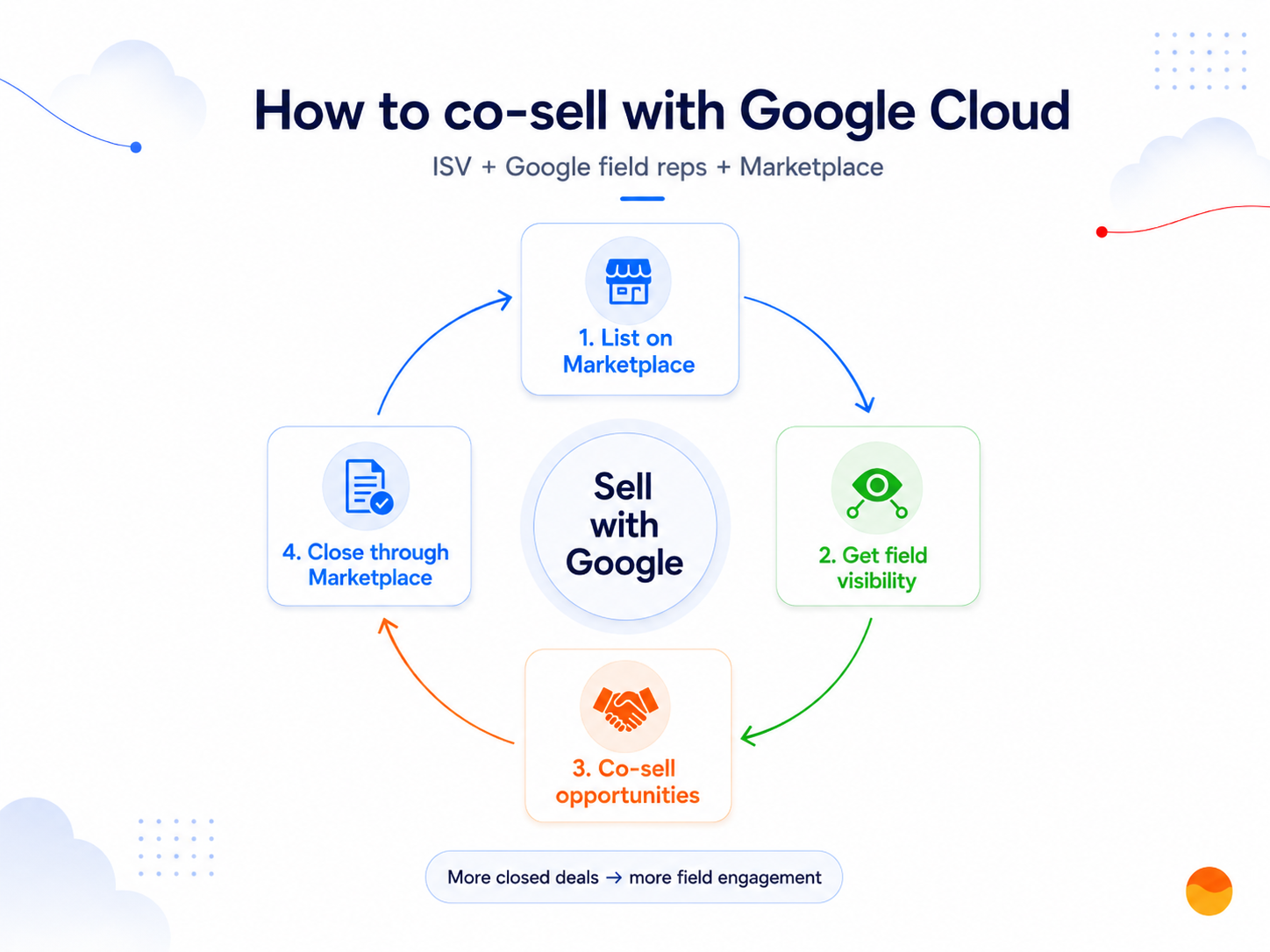
Co-selling is a joint go-to-market motion where an ISV and Google's sales teams work together to identify, qualify, and close customer deals — with Google Cloud Marketplace serving as the transaction and procurement layer. ISVs don't sell to Google or through Google. They sell with Google.
Who brings what:
| Party | Contribution |
|---|---|
| Google field reps | Customer relationship, account intelligence, procurement leverage |
| ISV | Product, pricing, customer success |
| Marketplace | Commercial workflow — private offers, billing, entitlements, commit drawdown |
For ISVs, co-selling unlocks four things direct sales motions can't replicate:
- Access to Google's enterprise customer relationships at organizations the ISV would struggle to reach cold
- Alignment of software purchases with the customer's existing Google Cloud commitment
- Faster procurement cycles via the buyer's existing GCP billing relationship
- Structural sales support — Google FSRs are financially incentivized to engage, with quota credit on Marketplace third-party deals and SPIFFs on closes
The co-sell flow typically runs:
- ISV lists on Marketplace and earns ISV Solution Connect status
- Deals are identified — either ISV-sourced (introduced to Google) or Google-sourced (the FSR brings the ISV into an existing conversation)
- The opportunity is registered and tracked to avoid channel conflict
- The deal closes through a Marketplace private offer or MCPO transaction
What is the Google Cloud Partner Network?
The Google Cloud Partner Network is Google's overarching partner program, restructured in Q1 2026 (replacing the long-running Partner Advantage program) around three tiers — Select, Premier, and Diamond — with automated tracking of customer outcomes and a competency framework that rewards co-sell contribution and certified skills rather than business-plan paperwork.
ISVs enroll under the Build engagement model, distinct from the Sell model (resellers) and Service model (SIs and consultancies).
Three things to know about the 2026 transition (announced by Colleen Kapase, VP Worldwide Partners & Alliances at Google Cloud, in late 2025):
- Tier promotion is outcomes-based. Movement between tiers depends on validated closed-won contributions and certification credentials, not narrative business plans.
- Diamond is intentionally selective, reserved for the highest-performing partners with deep co-sell engagement.
- Automation is real. Customer outcome tracking and program eligibility are measured automatically through CRM and Marketplace data.
Every existing partner needs to remap tier strategy and ensure Marketplace co-sell data is clean enough to feed automated tier evaluation. Suger keeps your co-sell pipeline, deal registrations, and tier-relevant outcomes in sync between your CRM and Google's partner systems automatically.
What is ISV Solution Connect?
ISV Solution Connect is Google Cloud's invitation-only co-sell program for Build-authorized partners with at least one paid Marketplace listing and a track record of transacting — typically two or more closed Marketplace deals. Members appear in Google's internal ISV Solution Connect Partner Directory in front of Google field sales reps, unlocking joint deal opportunities and direct field engagement on accounts where the ISV's product matches the customer's workload.
A strong listing and active transaction history attract field engagement; field engagement generates pipeline; pipeline drives more field interest. Without ISV Solution Connect membership, you're effectively invisible to Google's field motion regardless of listing quality.
Why are Google field reps incentivized to co-sell?
Google field sales reps receive quota attainment credit on Marketplace-routed third-party deals (most Marketplace solutions are quota-eligible), with SPIFFs available on closed co-sell deals. This is the structural foundation of the co-sell flywheel — Google's field is financially motivated to bring ISV products into customer conversations.
The operational implication: keeping deal registration and attribution in sync between your CRM and Google's partner systems becomes critical as concurrent co-sell opportunities grow. Without integration, attribution is unreliable, FSR credit gets misallocated, and leadership can't answer how much pipeline is partner-sourced versus partner-influenced. Suger syncs co-sell opportunities between your CRM and Google's partner systems in real time.
What programs and incentives does Google Cloud Marketplace offer ISVs?
Google offers ISVs several programs that materially change Marketplace economics. What's available depends on your tier, transaction history, and product category.
What is the Marketplace Customer Credit Program (MCCP)?
The Marketplace Customer Credit Program (MCCP) gives end customers up to 3% of their purchase in Google Cloud credits when they buy eligible third-party solutions through Marketplace for the first time. Credits apply to first-party Google Cloud services, effectively reducing the customer's net cost of a Marketplace purchase.
For ISVs, MCCP delivers three things:
- Shortens decision cycles by lowering net cost for the buyer
- Gives sellers a tangible incentive to pitch against alternatives
- Helps newer ISVs compete with established vendors
The program caps at approximately $8.3M annualized GTV in credits per eligible ISV.
What is the Marketplace Consumption Partner Offer program?
The Marketplace Consumption Partner Offer program rewards ISVs whose software meaningfully drives net-new Google Cloud consumption — data pipelines that increase BigQuery usage, ML platforms that drive Vertex AI consumption, or analytics products that scale customer storage and compute. Qualifying ISVs receive compensation on top of standard Marketplace software revenue.
If your product complements BigQuery, Vertex AI, Looker, Gemini, or Chronicle, you're in the cohort Google's GTM teams are structurally incentivized to amplify.
What is the Build engagement model on Google Cloud?
The Build engagement model is the ISV-specific track within the Google Cloud Partner Network. It's distinct from the Sell engagement model (resellers) and the Service engagement model (SIs and consultancies):
| Engagement model | Who it's for | What it unlocks |
|---|---|---|
| Build | ISVs | Marketplace publishing, ISV co-sell programs, technical enablement, certification path |
| Sell | Resellers, distributors | Reseller program enrollment, MCPO transactions |
| Service | SIs, consultancies | Service delivery programs, implementation partner status |
For most software companies, Build is the right model. Confirm your enrollment is under Build before investing meaningful time in listing or co-sell work.
Common Google Cloud Marketplace challenges and how to solve them
Each challenge below maps to a specific stage of maturity — and each has a clear fix.
What if my product isn't hosted on Google Cloud?
The single largest structural challenge for ISVs not already on Google Cloud is meeting the "primarily hosted on Google Cloud" requirement. Google validates this through the Solution Validation Form and accepts six architecture patterns, but the bar is real: the core scale, destination, or storage plane of your product must be on Google Cloud. ISVs primarily on AWS or Azure may need months of engineering work before they can list.
What to do: assess architectural fit before investing in listing prep. Map your product against Google's six accepted patterns. If the gap is small (replicating storage to GCS, deploying a control plane on GCP), the lift is manageable. If your entire data plane runs on a competing cloud, expect this to be a multi-quarter project, not a marketing milestone.
Why do manual private offer workflows fail at scale?
The first few private offers close through manual effort. Someone logs into the Producer Portal, builds the offer, emails the buyer, waits for acceptance, updates the CRM. At 5+ offers per month, four things break:
- Approvals get lost in email threads
- Offers expire before buyers accept
- Pricing errors surface in deals that already closed
- The team creating offers becomes a bottleneck
What to do: build approval workflows with clear routing. Set pre-approved pricing thresholds so standard deals move without manual sign-off. Connect offer creation to your CRM so reps work from one system. Suger lets your team create, route, and approve private offers directly inside Salesforce or HubSpot, with pre-filled pricing and deal terms pulled from the opportunity record.
How do I keep co-sell data in sync with my CRM?
Opportunities registered with Google through Partner Network Hub end up disconnected from your CRM. Attribution becomes unreliable. Leadership can't answer basic questions about partner-sourced versus partner-influenced pipeline — which becomes a serious problem when the Google Cloud Partner Network auto-evaluates tier eligibility from outcomes data.
What to do: integrate Google's partner systems with your CRM so deal registration and status sync automatically. Define attribution rules before volume makes retroactive classification impossible. Run regular data audits to catch sync gaps early. Suger handles this bi-directionally — co-sell opportunities, status changes, and field engagement signals flow between CRM and Google's partner systems without manual re-entry.
How do I reconcile Google Cloud Marketplace revenue in finance?
Google has its own disbursement timing (21st of the month), reporting formats, and fee structure that doesn't map cleanly to direct sales motions. The May 2025 variable revenue share added per-deal rate variation (1.5% / 2% / 3%). The Postpay Credits column tracks commitment credits applied to private offers, which has to be incorporated into your revenue recognition policy.
What to do: define rev rec policy for Marketplace transactions before deal volume makes it urgent. Set up disbursement tracking that maps Google payouts to internal records. Involve finance in Cloud GTM planning from the start — not after the first quarter-close panic. Suger automates disbursement reconciliation across all three major clouds and feeds clean revenue data into your ERP and finance stack.
How do I scale operations across AWS, Azure, and Google Cloud?
Each additional cloud marketplace adds a separate console, co-sell system, reporting stream, and disbursement process. The operational model you built for one marketplace needs to work across three or four. Challenges compound rather than parallel.
What to do: treat the second marketplace launch as process replication, not a net-new build. Centralize reporting, offer management, and revenue reconciliation across clouds before adding the third. Evaluate whether your current tooling supports multi-cloud or whether a unified platform like Suger is the right investment.
Best tools and platforms for Google Cloud Marketplace sellers
Cloud GTM platforms like Suger automate the operational work of selling through Google Cloud Marketplace:
- Listing management and Procurement API integration
- Private offer workflows
- MCPO orchestration
- Co-sell synchronization with Google's partner systems
- Usage metering
- Disbursement reconciliation
Operational work grows linearly with deal volume when managed manually. The scaling curve becomes unsustainable past a few enterprise transactions per month.
When do you need a Cloud GTM platform for Google Cloud Marketplace?
Six signals it's time:
- Engineering bandwidth is the listing bottleneck. Direct Cloud Commerce Partner Procurement API integration takes ongoing engineering time a platform eliminates.
- Private offer volume is climbing. Manual creation in the Producer Portal becomes a bottleneck around five offers per month.
- Co-sell motion is scaling. Manual sync between Google's partner systems and your CRM means attribution stays unreliable — a tier-eligibility problem under the Google Cloud Partner Network.
- Finance is spending hours on reconciliation. Each deal adds disbursement tracking, fee matching, Postpay Credits accounting, and reporting work.
- You're launching on a second marketplace. A separate console, co-sell system, and reporting stream doubles operational overhead per new cloud.
- Reps avoid Marketplace deals. If the workflow is slower than their standard CRM process, the channel stalls regardless of buyer demand.
What features should a Cloud GTM platform have?
| Capability | What to evaluate |
|---|---|
| Marketplace coverage | AWS, Azure, and Google Cloud at minimum; some platforms also support Snowflake or other emerging marketplaces |
| Procurement API integration | Does the platform handle Cloud Commerce Partner Procurement API integration end-to-end, or do you still need engineering work? |
| Private offer workflows | Can your team create, route, approve, and track private offers from inside your CRM rather than the Producer Portal? |
| MCPO orchestration | Can it manage reseller private offer plans, parent/sub-billing account discount management, and channel deal attribution? |
| Co-sell automation | Bi-directional sync between CRM and Google's partner systems? Automatic deal registration? Real-time status updates? |
| Quote-to-cash depth | How far past listing and offers does it extend — CPQ, metering, billing, disbursement reconciliation, ERP sync? |
| Usage metering and billing | Can it report SaaS usage to Service Control within Google's one-hour window? Does it flow into your billing system (Stripe, Metronome, Orb, Chargebee)? |
| CRM and finance integrations | Salesforce and HubSpot as baseline; does it connect to your billing system, accounting software, data warehouse? |
| AI Agent Marketplace support | Does it handle Agent Card (A2A protocol) listing workflows for the AI Agent Marketplace? |
Which Cloud GTM platform is best for Google Cloud Marketplace in 2026?
Suger is the most comprehensive Cloud GTM platform for Google Cloud Marketplace operations. It covers the complete Marketplace lifecycle in a single system: listing, private offers, MCPO, co-sell, CPQ, metering, billing, revenue reconciliation, and ERP sync.
Three capabilities set Suger apart:
- Quote-to-cash automation built for Google's commercial model. Suger is the only platform connecting the full deal flow from CPQ quote to Marketplace private offer to entitlement to revenue recognition, including Postpay Credits tracking and the May 2025 variable revenue share tiers.
- Usage metering and billing flexibility for Service Control. Suger meters consumption across AWS, Azure, and Google Cloud from a single interface, with data flowing directly into Stripe, Metronome, Orb, and Chargebee — and reports SaaS usage to Google Service Control inside the required one-hour window.
- Broadest multi-cloud coverage in the category. Five marketplaces supported (AWS, Azure, Google Cloud, Snowflake, Alibaba). Listings, offers, co-sell, and reporting run from one system with 30+ native integrations.
250+ software companies use Suger, including Intel, Snowflake, Notion, Webflow, and Fivetran. Customers report a 3x increase in Marketplace deal volume and 140% higher contract values. Ready to scale on Google Cloud Marketplace? Talk to us.
Frequently asked questions
What is Google Cloud Marketplace? +
Google Cloud Marketplace is a digital storefront where customers discover, purchase, and deploy third-party software, AI agents, and datasets using their existing Google Cloud billing relationship. It supports SaaS, Compute Engine VM products, Kubernetes apps, container images, BigQuery datasets, professional services, foundation models, and AI agents listed in the dedicated AI Agent Marketplace.
How much does Google Cloud Marketplace cost? +
Google Cloud Marketplace charges a variable revenue share: 3% on standard public offers and private offers under $1M TCV, 2% on private offers $1M–$10M, and 1.5% on private offers above $10M and on all renewals. Channel-routed deals through MCPO carry no incremental fee to the ISV. The variable structure took effect May 15, 2025.
What pricing models does Google Cloud Marketplace support? +
Google Cloud Marketplace supports six pricing models: free, BYOL (VM and Kubernetes only), subscription, usage-based metered, combined subscription-plus-usage (SaaS only), and private offers with custom commercial terms. SaaS products support up to 24 pricing plans and up to eight metrics per usage-based plan.
How long does it take to list on Google Cloud Marketplace? +
Google publishes stage-level timing rather than an end-to-end SLA: pricing review takes up to four business days, some component reviews take up to two weeks, and VM products can go public within minutes once final approvals land. The realistic end-to-end timeline for a well-prepared SaaS ISV is 8–16 weeks.
What is a private offer on Google Cloud Marketplace? +
A private offer is a customer-specific commercial agreement with negotiated pricing, payment schedules, and term length. It supports flat-fee, usage-discount, commit-discount, and hybrid pricing structures, with payment schedules from monthly to fully custom installments, prepay up to 5 years, and contract terms up to 7 years. Multiple concurrent active offers for the same customer are supported as of April 2025.
What is MCPO on Google Cloud Marketplace? +
MCPO — Marketplace Channel Private Offers — is the path for authorized Google Cloud channel partners to extend private offers to customers on the ISV's behalf. Partners own billing, invoicing, and topline revenue recognition. Since June 9, 2025, qualifying MCPO transactions deliver 100% Google Cloud commit drawdown (capped at 25% of total commitment).
What is the Google Cloud Marketplace Reseller Program? +
The Google Cloud Marketplace Reseller Program is the partner-side enrollment structure that authorizes channel partners — resellers, SIs, MSPs — to resell ISV Marketplace products to end customers. Partners enroll under the Sell engagement model within the Google Cloud Partner Network. The program works in tandem with MCPO: the Reseller Program is the authorization layer; MCPO is the deal mechanism.
What is co-selling on Google Cloud Marketplace? +
Co-selling is a joint go-to-market motion where an ISV and Google's sales teams work together to identify, qualify, and close customer deals — with Google Cloud Marketplace serving as the transaction layer. ISVs don't sell to or through Google; they sell with Google. Google FSRs receive quota credit and SPIFFs on closed co-sell deals, making field engagement a structural priority rather than a favor.
Does Google Cloud Marketplace count toward committed spend? +
Yes. Marketplace purchases count against the customer's Google Cloud Committed Spend (GCC) agreement. As of June 9, 2025, qualifying MCPO transactions deliver 100% commit drawdown tied to the final negotiated private offer price, capped at 25% of the total commitment.
What is the Marketplace Customer Credit Program (MCCP)? +
The Marketplace Customer Credit Program (MCCP) gives customers up to 3% in Google Cloud credits when they purchase eligible third-party solutions through Marketplace for the first time. Credits apply to Google Cloud first-party services. The program caps at approximately $8.3M annualized GTV in credits per eligible ISV.
What is ISV Solution Connect? +
ISV Solution Connect is Google's invitation-only co-sell program for Build-authorized partners with at least one paid Marketplace listing and typically 2+ closed Marketplace deals. Members appear in Google's internal partner directory in front of field sales reps and unlock joint deal opportunities.
What is the Google Cloud Partner Network? +
The Google Cloud Partner Network is Google's overarching partner program, restructured in Q1 2026 (replacing Partner Advantage) around three tiers — Select, Premier, and Diamond. Tier promotion is outcomes-based, driven by validated closed-won contributions and certification credentials rather than business-plan paperwork. ISVs enroll under the Build engagement model.
Can I list on Google Cloud Marketplace if my product runs primarily on AWS or Azure? +
Not under standard onboarding. Google requires that products be primarily hosted on Google Cloud, validated through the Solution Validation Form. Six architecture patterns are accepted, but the core compute/data plane or storage must be on Google Cloud. ISVs primarily on AWS or Azure may need significant architectural work before they can list.
Can I change my pricing model after listing on Google Cloud Marketplace? +
Pricing model changes are gated by a minimum 30-day window between price changes after publication. Structural decisions are more permanent — Product ID and solution type cannot be changed after creation. Choose your model carefully with downstream deal structures in mind.
How do Google Cloud Marketplace disbursements work? +
Google bills the customer, collects payment, and disburses to the ISV on a monthly cycle — typically the 21st of the month following the customer billing cycle. ISVs do not invoice Google directly. Reports are available in BigQuery. A Postpay Credits column tracks commitment credits applied to private offers.
What is the AI Agent Marketplace on Google Cloud? +
The AI Agent Marketplace is a dedicated category launched at Google Cloud Next '25 (April 2025) for agentic AI products. Agents are listed with Agent Cards — JSON metadata files conforming to the A2A protocol — and appear directly inside Gemini Enterprise's Agent Gallery. By Next '26, the catalog had grown to 70+ validated partner agents. The A2A protocol moved to neutral governance under the Linux Foundation's Agentic AI Foundation in April 2026.
How is Google Cloud Marketplace different from AWS Marketplace? +
Three structural differences matter for ISVs: Lower fees on large deals — Google's variable revenue share drops to 1.5% on private offers above $10M and on all renewals, while AWS Marketplace charges 1.5–3% on tiered private offers but applies a flat 3% on SaaS public offers and 20% on server listings. Topline revenue for resellers — Google Cloud channel partners recognize the full transaction value as revenue, while AWS CPPO resellers typically recognize only margin between wholesale and customer price. AI Agent Marketplace — Google has a dedicated category for AI agents surfaced through Gemini Enterprise's Agent Gallery, a distribution surface AWS doesn't currently offer.
What is a Cloud GTM platform? +
A Cloud GTM platform (for e.g Suger) automates the operational work of selling through cloud marketplaces: listing management, Procurement API integration, private offer workflows, channel partner orchestration, co-sell synchronization, usage metering, billing, and revenue reconciliation. Platforms like Suger let ISVs operate marketplace motions across AWS, Azure, and Google Cloud from a single CRM-embedded interface.