


Introduction
Cloud marketplaces have become a serious growth channel for software companies. They are no longer just places to list software and hope buyers find it. Today they sit much closer to revenue, procurement, cloud budget, partner motions, and enterprise deal execution.
For many software companies, getting into AWS Marketplace, Microsoft Marketplace, or Google Cloud Marketplace is a way to meet buyers where they already want to buy. It can speed up procurement, align deals with existing cloud commitments, and create more flexibility through private offers and partner-led selling motions.
That said, cloud marketplaces are still widely misunderstood. Many teams think success starts and ends with getting a listing live. It doesn't. Listing is the starting point. The real work begins after that — choosing the right marketplace, setting up the right offer structure, enabling private offers, aligning internal teams, and building a process that sales, partnerships, finance, and operations can support.
In this guide, we cover the fundamentals, break down the differences between AWS, Azure, and GCP, explain private offers and channel partner private offers, and show what SaaS companies need to get right if they want marketplace to become a repeatable revenue channel.
What Is a Cloud Marketplace?
A cloud marketplace is a digital storefront run by a cloud provider — AWS, Microsoft Azure, or Google Cloud — that lets software companies list and sell their products through the cloud platforms their buyers already use.

At a basic level, the model sounds simple. A vendor lists software, a buyer discovers it, evaluates whether it fits, and decides whether to purchase. In practice they do much more than that. Cloud marketplaces sit at the point where software buying, procurement, billing, and cloud relationships meet. That is what makes them commercially important for independent software vendors (ISVs).
- For buyers, marketplaces can mean easier purchasing, faster internal approvals, and the ability to use existing cloud budgets.
- For sellers, they can mean better access to enterprise accounts, smoother procurement conversations, and more flexible ways to structure deals.
- For partners, they can open the door to resale motions and private offer workflows that would be harder to manage outside the marketplace.
This is also why cloud marketplaces need to be understood properly. They are often mistaken for simple software directories when, in reality, they play a much bigger role in how enterprise software gets evaluated, purchased, and transacted. Large buyers don't just care about product features. They also care about how the product is approved, how it is billed, and whether it fits a purchasing path they already trust.
In practice, cloud marketplaces work best when they are treated as part of a broader Cloud go-to-market (Cloud GTM) motion.
What Are the Benefits of Selling on Cloud Marketplaces?
Unlike traditional direct software procurement, cloud marketplaces let enterprises complete the transaction within an existing cloud provider relationship. That changes how software is approved, contracted, billed, and purchased.
Traditional enterprise procurement is slow by design. A team identifies the right solution, but the deal gets delayed by vendor onboarding, security reviews, legal redlines, separate billing setup, and budget approval workflows. Every new vendor introduces another contract, another approval path, another review.
Cloud marketplaces work differently. They move the transaction into a commercial framework the buyer already uses with AWS, Microsoft, or Google Cloud. The result is not just a new buying channel — it's a shorter, more structured route to purchase.
1. Cloud commit drawdown
A traditional software purchase usually needs its own budget approval. A marketplace transaction can look very different. Large enterprises often have major multi-year commitments with AWS, Microsoft, or Google Cloud. Marketplace allows part of that cloud spend to be used on third-party software, which means the purchase is often closer to a budget that is already approved. For buyers, this reduces the financial approval burden. For sellers, it can turn a stalled procurement conversation into a workable commercial path.
2. Standard legal contracts
Legal review is one of the most common reasons enterprise deals slow down. In a direct procurement model, every new vendor can trigger a fresh contract review — separate terms negotiated for each software purchase. Cloud marketplaces reduce part of that burden by offering standardized agreement structures and pre-established legal frameworks. That doesn't remove legal review entirely, but it gives buyers and sellers a stronger starting point than a brand-new papering process for every deal.
3. Unified vendor management
Direct procurement creates operational overhead. Finance and accounts payable teams have to manage separate invoices, tax records, payment workflows, and compliance records for every software vendor. As software stacks grow, that becomes harder to manage. Marketplace consolidates more of that activity inside the buyer's cloud purchasing environment — Microsoft, for example, says customers purchasing through Microsoft Marketplace receive a single, consolidated monthly bill that includes both Azure charges and Marketplace purchases. That kind of consolidation gives procurement and finance teams better visibility into software spend and reduces the administrative load that comes with managing every vendor separately.
Who uses cloud marketplaces?
Cloud marketplaces are built for multiple types of users, including SaaS vendors, buyers, channel partners, resellers, and the cloud providers themselves. One company may look at marketplace as a new sales channel. Another may look at it as a procurement tool. A partner may see it as a resale motion. A finance team may see it as a cleaner buying path. All of those views can be true at the same time. That's part of why marketplace programs get complex so quickly: different teams use the same platform for different reasons.
Software buyers
Software buyers are one of the main groups driving cloud marketplace growth. These are companies that already have strong relationships with AWS, Azure, or Google Cloud. They may already be running workloads there, already have procurement processes tied to those clouds, and already have committed spending in place. For them, buying software through a cloud marketplace can feel easier than going through a completely separate vendor workflow.
Instead of starting from scratch, they can often:
- Buy through a known cloud environment
- Work within existing billing structures
- Simplify internal approvals
- Align purchases with cloud budget planning
- Move faster on software that already fits their stack
SaaS vendors / ISVs
For software vendors, cloud marketplaces can serve several goals at once. First, they create another revenue stream. Second, they make enterprise selling easier. Third, they strengthen relationships with cloud providers and partners. Vendors don't all use marketplace the same way — some use it mainly as a procurement path for direct deals, others to support co-sell motions, others to expand partner-led sales, and others as a strategic channel that needs its own operations, reporting, and growth plan.
Channel partners and resellers
Channel partners and resellers use cloud marketplaces differently. For them, marketplace can create a structured way to participate in software deals without stepping outside the cloud provider's commercial framework. This is especially important in partner-led enterprise selling, where the partner may already have the customer relationship, procurement influence, or contract path. Channel partner private offers give resellers a more formal way to participate in cloud marketplace transactions.
Cloud providers
AWS, Microsoft, and Google Cloud run marketplaces to drive more software and services through their ecosystems. The more valuable their marketplace, the stronger their cloud platform becomes. That's why cloud providers invest heavily in marketplace programs, partner motions, and co-sell activity.
AWS vs Microsoft vs Google Cloud Marketplace: A Side-by-Side Comparison
When people talk about cloud marketplaces, they usually mean the three largest: AWS Marketplace, Microsoft Marketplace, and Google Cloud Marketplace. At a high level, all three help software companies sell through cloud buying paths customers already use. The differences show up in product terminology, marketplace structure, partner motions, and how each platform fits different buyer environments.
AWS Marketplace: overview, fees, and best use cases
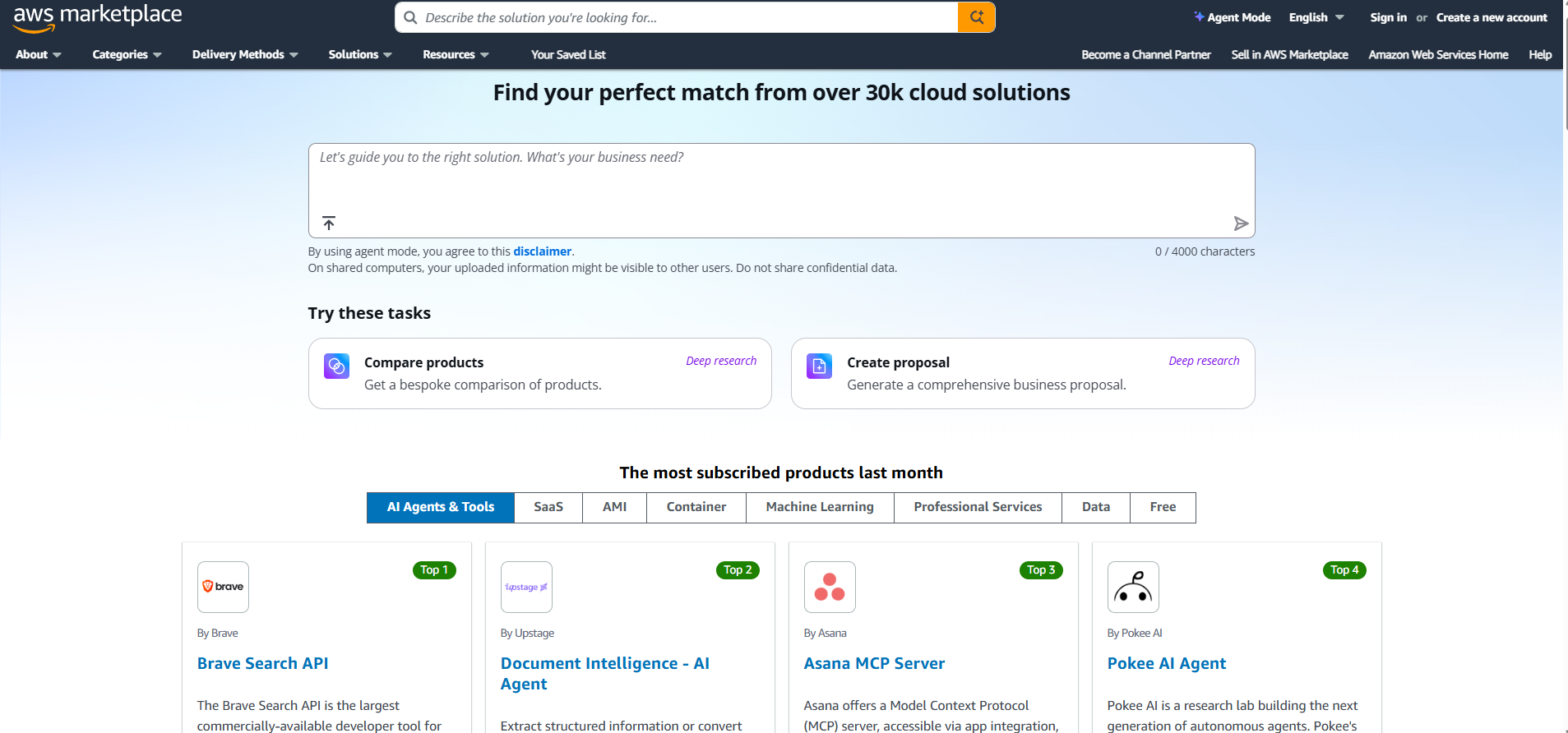
AWS Marketplace is often the first platform SaaS teams consider because of its depth, breadth of products, and strong enterprise relevance. AWS positions it as a sales channel for ISVs and consulting partners, and supports a wide range of delivery methods: SaaS, Amazon Machine Image (AMI) products, container images, Helm charts, EKS add-ons, data products, and professional services. That makes AWS a strong starting point for companies that need support for multiple delivery models in one marketplace.
| Item | AWS Marketplace |
|---|---|
| Listing fee to publish | No upfront listing fee |
| Public SaaS offer fee | 3% |
| Public server product fee | 20% for AMI, container, and ML products |
| Public data product fee | 3% |
| Private offer fee < $1M TCV | 3% |
| Private offer fee $1M–$10M TCV | 2% |
| Private offer fee $10M+ TCV | 1.5% |
| Private offer renewals | 1.5% |
| CPPO uplift | +0.5% on the applicable listing fee |
Fees are based on pre-tax total contract value; regional listing fees may also apply in some jurisdictions. For the full AWS Marketplace deep-dive, see the dedicated AWS Marketplace guide.
Microsoft Marketplace (formerly Azure Marketplace): overview, fees, and best use cases
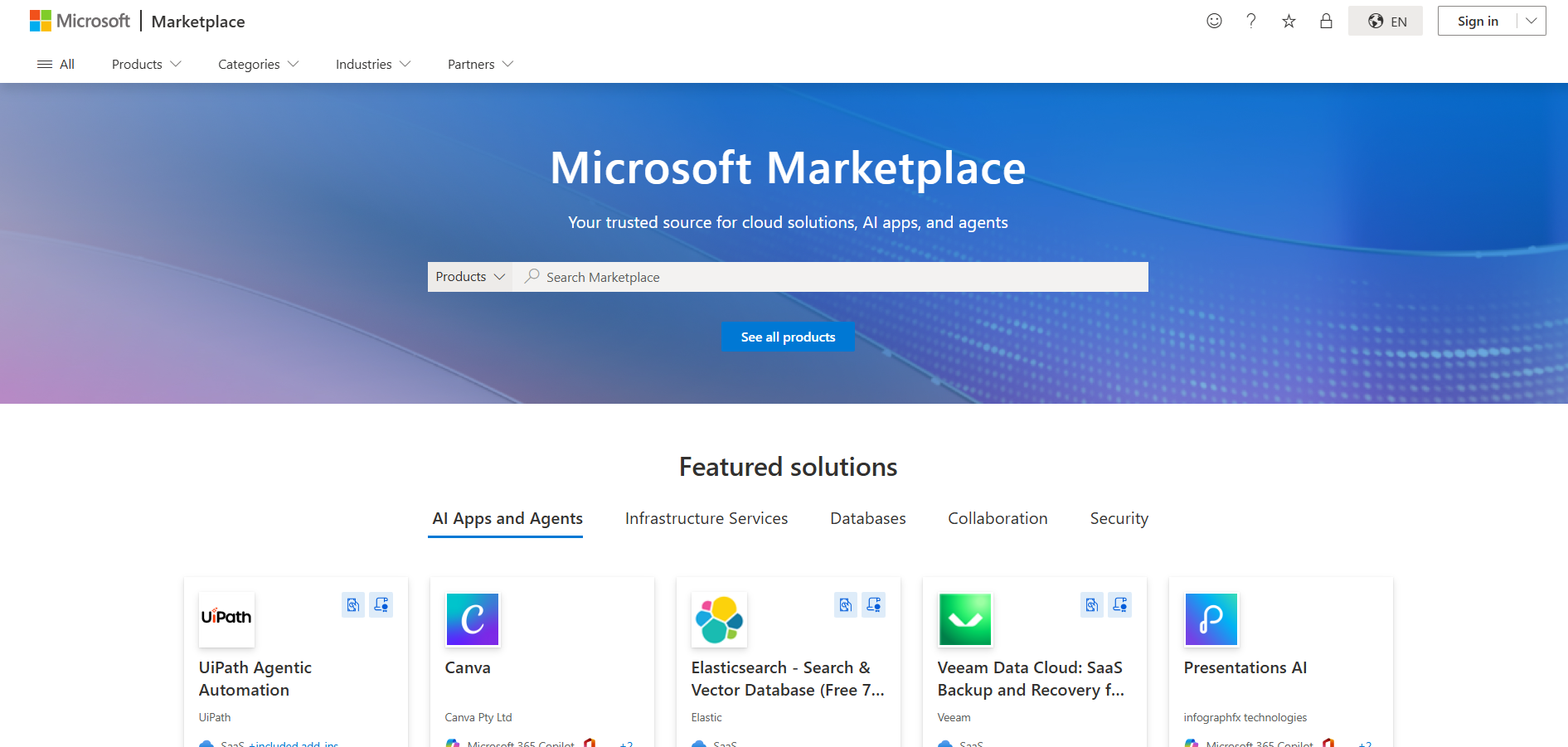
Microsoft Marketplace is a single destination for customers to find, try, and buy cloud solutions and AI agents, with offers also surfacing through Microsoft sales teams, reseller channels, and in-product experiences. The wider commercial footprint is one of its biggest strengths.
Microsoft consolidated Azure Marketplace and AppSource into a single Microsoft Marketplace in September 2025, creating a unified buying experience across infrastructure, SaaS, and business applications. Azure Marketplace targets IT professionals and developers looking for cloud infrastructure tools, database management solutions, and cybersecurity platforms.
Microsoft has also modernized its channel operations with the Multiparty Private Offer (MPO) capability. This allows ISVs to authorize specialized Microsoft partners to package custom services alongside the software license, presenting a unified solution to the enterprise buyer on a single Microsoft invoice.
| Item | Microsoft Marketplace |
|---|---|
| Listing fee to publish | No |
| Standard transaction fee | 3% |
| When it applies | When customers purchase a transactable offer through Microsoft Marketplace |
| Notes | BYOL and certain infrastructure costs may follow different billing logic depending on offer type |
For the full Microsoft Marketplace deep-dive, see the dedicated Azure Marketplace guide.
Google Cloud Marketplace: overview, fees, and best use cases
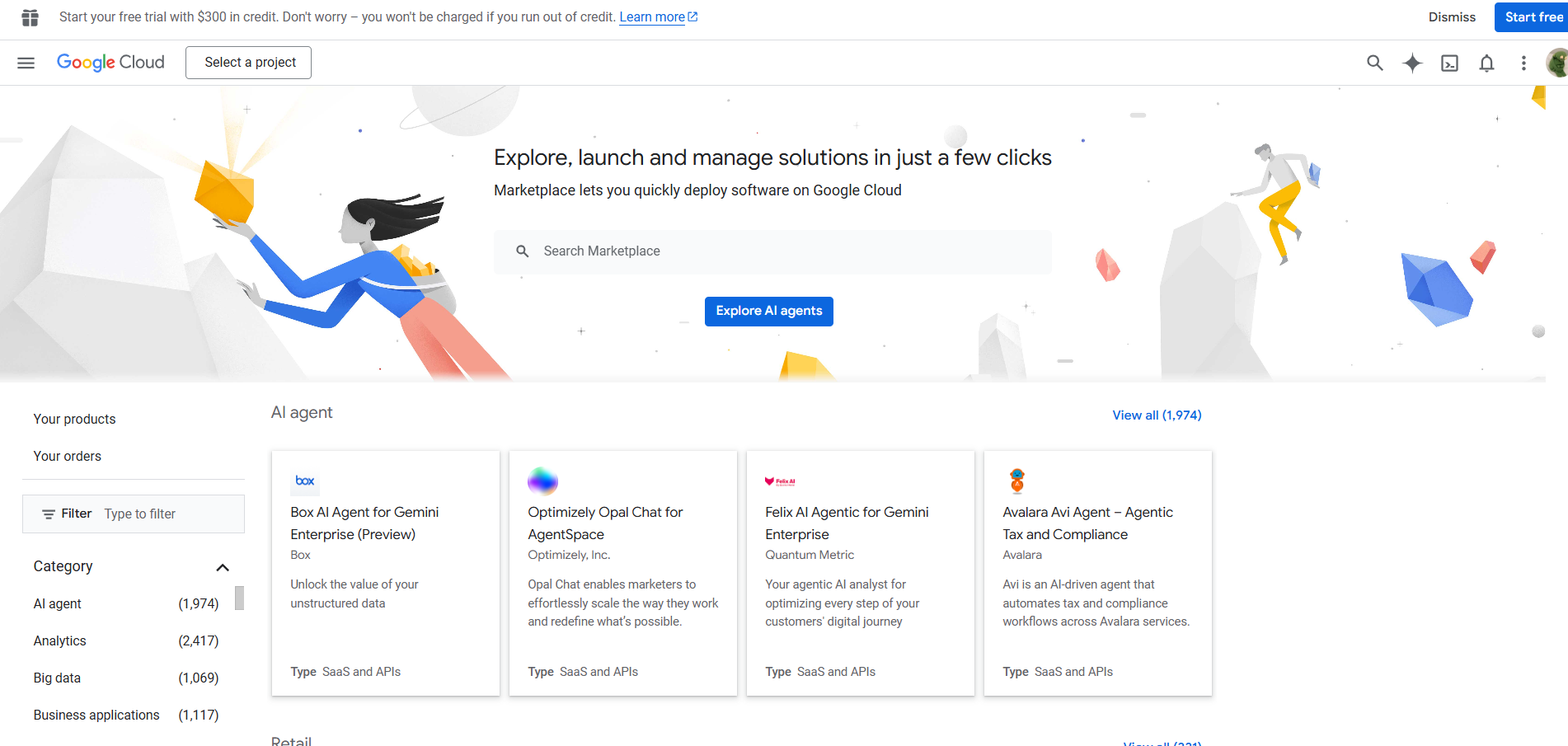
Google Cloud Marketplace positions itself as the premier destination for organizations prioritizing data analytics, machine learning, and open-source infrastructure. It places a strong emphasis on procurement simplification, cloud commitment drawdown, deployment speed, governance, and billing visibility within the Google Cloud Console. It's often the best fit when the buyer and product are already closely aligned with GCP.
| Item | Google Cloud Marketplace |
|---|---|
| Listing fee to publish | Not presented as a flat listing fee |
| Revenue share model | Variable |
| Effective date of current schedule | April 21, 2025 |
| Indicative range | As low as 1.5% for eligible deals; smaller new private offers commonly start near 3% |
| Notes | Revenue share depends on deal type and total contract value under Google's Vendor Net Revenue Schedule |
Google Cloud's seller economics are no longer best described as one flat fee. They vary by deal type and contract value, so teams should check the current Vendor Net Revenue Schedule before modeling margin. For the full Google Cloud Marketplace deep-dive, see the dedicated GCP Marketplace guide.
Key differences: AWS vs Microsoft vs Google Cloud Marketplace
| Area | AWS Marketplace | Microsoft Marketplace | Google Cloud Marketplace |
|---|---|---|---|
| Positioning | Broad sales channel for ISVs and consulting partners | Single destination for cloud solutions and AI agents across Microsoft ecosystem | Universal catalog of validated Google and partner solutions |
| Buyer experience | Strong breadth across software, data, services, and deployment models | Strong fit for Microsoft-led commercial environments | Strong fit for GCP-centered procurement, governance, and deployment |
| Commitment / spend angle | Strong enterprise procurement relevance | Strong fit inside Microsoft commercial buying motion | Explicitly highlights commitment drawdown |
| SaaS support | Yes | Yes | Yes |
| VM terminology | Amazon Machine Image (AMI) | Azure Virtual Machine | VM products / VM images |
| Container terminology | Container image, Helm chart, EKS add-ons | Azure container | Kubernetes apps / container image products |
| Partner-led private-offer term | CPPO | MPO / Multiparty Private Offers | MCPO / Marketplace Channel Private Offers |
| Seller onboarding feel | Broad marketplace with many delivery methods | Offer-type and plan driven through Partner Center | Producer Portal + structured product integration workflow |
How Do Cloud Marketplaces Work?
Once you understand what a cloud marketplace is, the next step is understanding how deals actually move through one.
The 7 stages of a cloud marketplace deal
Most cloud marketplace deals move through the same broad stages.
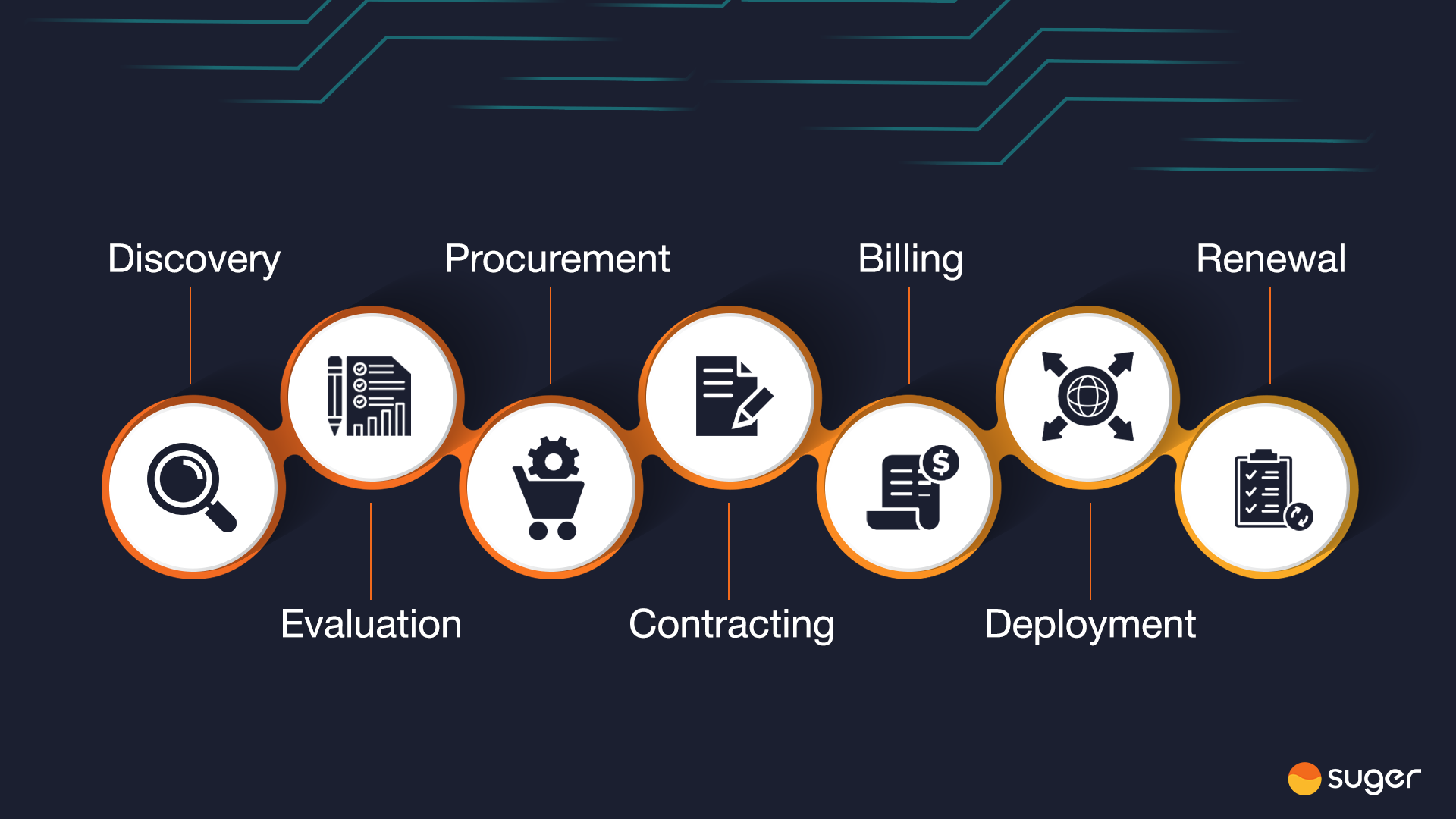
Discovery is where the buyer first encounters the product. Sometimes that happens inside the marketplace itself through search or category browsing; sometimes it happens outside the marketplace through sales, partner referrals, analyst research, or cloud co-sell activity. The strongest marketplace deals don't begin with organic marketplace browsing at all — they begin with demand that marketplace later helps convert into a cleaner purchase path.
Evaluation is where the buyer decides whether the product fits. The marketplace listing may help with product understanding, pricing visibility, technical packaging, and purchase readiness, but it's often only one input. Buyers still look at documentation, demos, implementation effort, security, and internal fit. A strong listing supports evaluation, but it rarely replaces the broader buying process for larger accounts.
Procurement is where marketplace often starts doing its real work. AWS notes that buying a product in AWS Marketplace means accepting the pricing terms and the seller's EULA shown on the product detail page — treating the marketplace as a formal purchase channel rather than a lead source. Microsoft explicitly frames marketplace purchasing as a way to avoid managing separate vendor invoices, offering a consolidated bill alongside Azure charges. Marketplace becomes most valuable when a customer wants to buy, not just browse.
Contracting is where things stop being generic. Public listing terms may be enough for smaller or more standardized purchases, but enterprise deals often need custom pricing, custom terms, proof-of-concept structures, or partner involvement. AWS, Microsoft, and Google Cloud all support private offers, but the surrounding terminology and capabilities differ — Microsoft's private offers, for example, can include custom terms and customized pricing for up to five years and bundle up to 10 products from the same vendor.
Billing follows the cloud provider's model. That matters more than it sounds. For many customers, the appeal of marketplace is how the purchase shows up inside their financial systems. Microsoft's marketplace purchases can appear on a single, consolidated monthly bill alongside Azure charges. AWS and Google frame private offers around custom pricing and accepted terms tied to specific buyer accounts.
Deployment comes after the deal is accepted, but this step varies heavily by product type. A SaaS product may be activated with account provisioning and entitlement. A VM or AMI product may need to be launched into a customer's environment. A Kubernetes or container product may involve deployment into an existing cluster.
Renewal is the stage many teams think about too late. Once a product is live and paid for through marketplace, the next questions become commercial and operational: renew on the same terms, expand the contract, move to a new private offer, or purchase additional products. Google's private offer documentation notes that when a contract ends, customers can continue at list price for some models or work with the vendor to renew. Renewal is an active marketplace motion, not a passive afterthought.
How billing and cloud commit drawdown work
Billing is one of the biggest reasons marketplace matters in the first place. In a direct software purchase, the buyer usually has to create a separate vendor path, manage a new invoicing flow, and get internal approval for it. Marketplace reduces that friction by letting the purchase happen through cloud channels the buyer already uses.
This becomes even more important when cloud commitments come into play. Many large customers already have major spend committed to AWS, Azure, or Google Cloud. In those cases, marketplace becomes the preferred buying route because it fits naturally into existing cloud budgets and internal approval structures.
Cloud marketplace product types: SaaS, VM, container, and more
Not every marketplace product behaves the same way after purchase.
For SaaS products, the deployment step is usually the lightest. The buyer purchases through the marketplace, but the product itself is accessed in the vendor's own environment. AWS's buyer documentation is clear: for SaaS products, customers subscribe through AWS Marketplace but use the software in the seller's environment.
For VM- or AMI-based products, the software is deployed to the buyer's cloud environment. That makes the post-purchase flow more infrastructure-heavy. The buyer isn't just accepting terms — they're standing up software inside their own environment.
For container or Kubernetes products, deployment is more cloud-native. AWS says container products can be delivered through container images, Helm charts, or Amazon EKS add-ons, while Google describes Kubernetes apps as bundles of container images, configuration files, and display metadata that run on Kubernetes clusters.
For managed application-style offers, there's usually more structure around installation, dependencies, and cloud configuration. For API or data products, deployment may be less about standing up infrastructure and more about granting access, connecting usage, or enabling data delivery.
The 8 Stages Of Cloud Marketplace Buyer's Journey
From the buyer's side, marketplace usually becomes important when interest turns into action. A buyer may first hear about a product through a salesperson, a partner, a cloud rep, a referral, or prior research. But once the conversation shifts from "this looks useful" to "how do we actually buy it?" — marketplace often becomes the practical route forward.
The buyer journey moves through eight stages: awareness, evaluation, internal alignment, channel decision, commercial review, purchase, activation, and renewal.
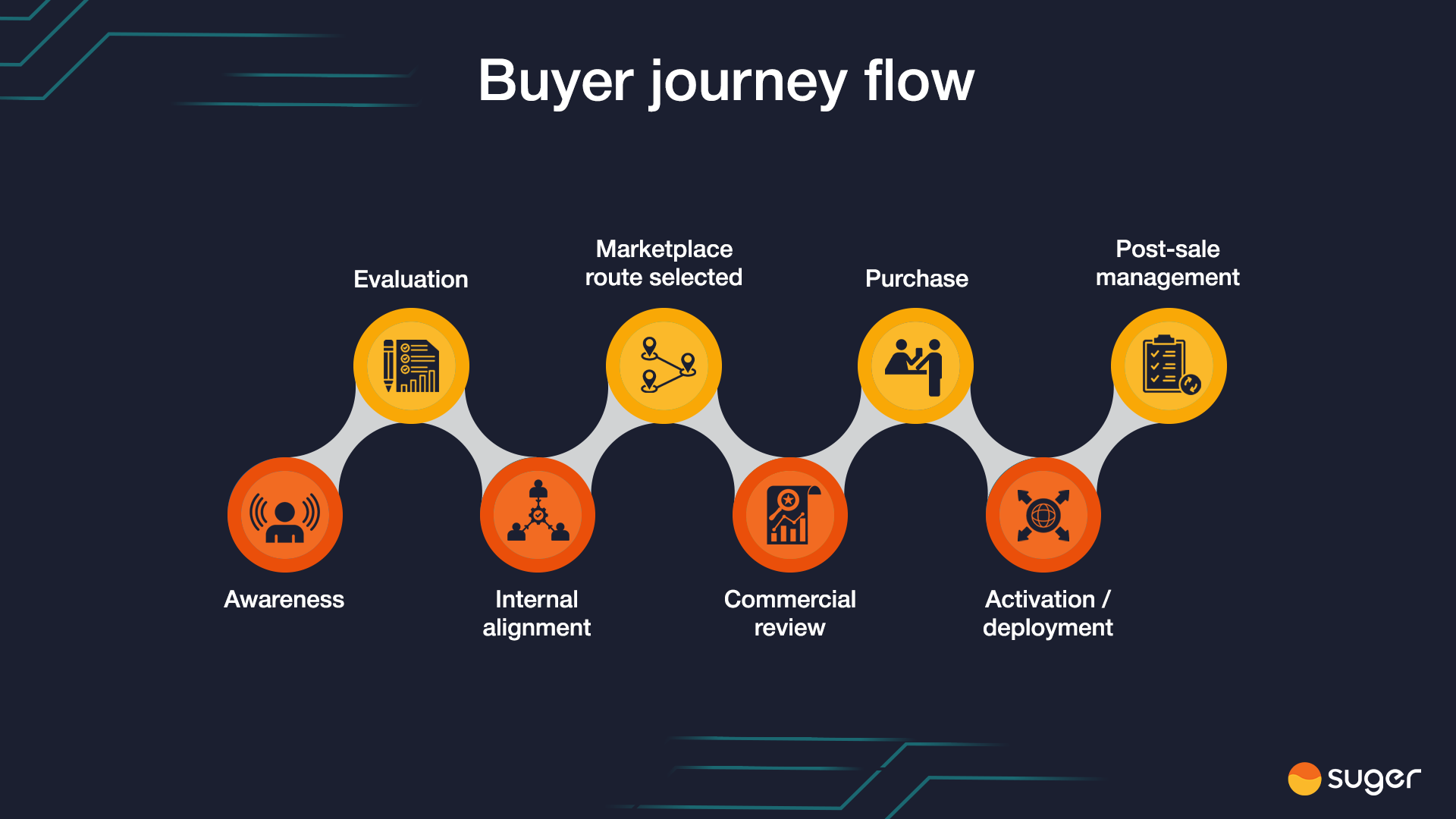
| Stage | What the buyer is doing | What matters most at this point |
|---|---|---|
| Awareness | Learns about the product through sales, partners, cloud reps, referrals, or direct research | Relevance, credibility, and fit with current needs |
| Evaluation | Reviews product capabilities, technical fit, pricing approach, and internal use case | Security, integrations, implementation effort, ROI, and product maturity |
| Internal alignment | Brings in procurement, finance, IT, legal, or cloud teams as needed | Whether the product can be approved and purchased smoothly |
| Marketplace route selected | Decides to buy through AWS, Azure, or GCP instead of opening a separate vendor path | Billing convenience, internal approval speed, and cloud budget alignment |
| Commercial review | Reviews public pricing or requests a private offer with custom pricing or terms | Contract flexibility, cost structure, and deal fit |
| Purchase | Completes the transaction through the chosen marketplace | Ease of procurement, billing clarity, and account-level approval |
| Activation / deployment | Gains access to the product or deploys it based on product type | Fast onboarding, smooth provisioning, and minimal technical friction |
| Renewal or expansion | Renews the contract, expands usage, or negotiates a new offer | Ongoing value, account growth, and commercial flexibility |
The 8 Stages of a Cloud Marketplace Seller's Journey
From the seller's side, marketplace is much more operational than it looks from the outside. A company doesn't just publish a listing and wait for revenue to appear. It has to prepare the product, choose the right marketplace, structure pricing, support procurement conversations, enable private offers, and make sure internal teams know how to use marketplace during real deals.
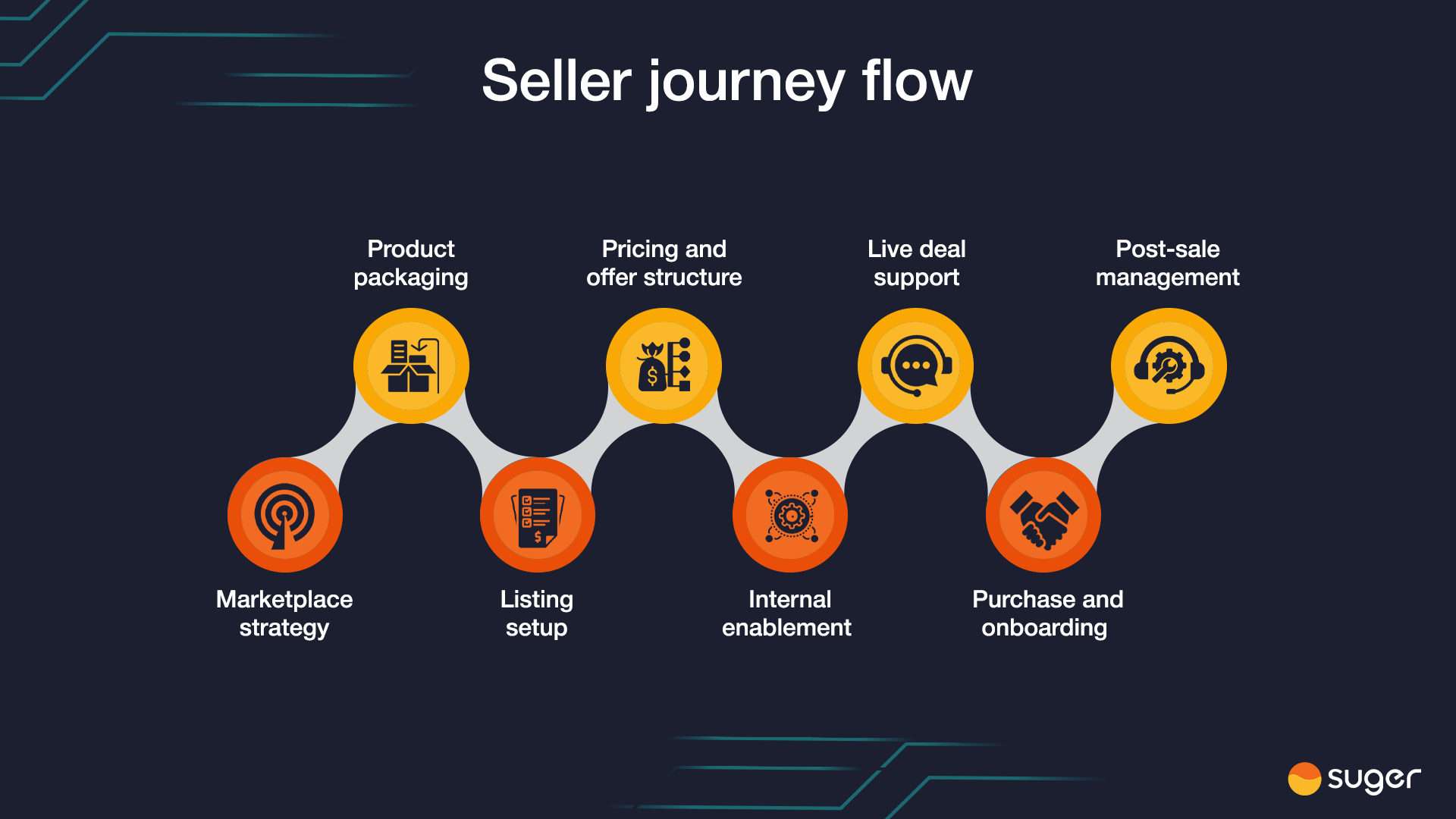
| Stage | What the seller is doing | What matters most at this point |
|---|---|---|
| Marketplace strategy | Decides why marketplace matters and which platform to prioritize | Buyer demand, cloud alignment, sales motion, and operational readiness |
| Product packaging | Prepares the product for marketplace based on its format and deployment model | Technical fit, clear packaging, and marketplace compatibility |
| Listing setup | Builds and publishes the marketplace listing | Clear positioning, accurate information, and strong buyer confidence |
| Pricing and offer structure | Sets public pricing and prepares for private offers or partner-led motions | Flexibility, margin protection, and commercial clarity |
| Internal enablement | Aligns sales, partnerships, finance, legal, and ops around marketplace workflows | Ownership, readiness, and cross-functional coordination |
| Live deal support | Uses marketplace in actual sales cycles, often when procurement gets involved | Speed, responsiveness, and the ability to support complex deal needs |
| Purchase and onboarding | Supports the transaction and ensures the customer gets activated smoothly | Clean handoff, fast provisioning, and low-friction onboarding |
| Post-sale management | Tracks renewals, expansions, reporting, and marketplace performance | Retention, upsell potential, and operational consistency |
What Are The Benefits of Selling on Cloud Marketplaces for ISVs
Once an ISV understands how cloud marketplaces work, the bigger question becomes: why invest in them at all? For software companies, cloud marketplaces can strengthen how deals are structured, how partnerships are activated, how enterprise accounts are entered, and how revenue operations scale over time.
Faster procurement for enterprise buyers
For software sellers, faster procurement shortens the distance between buyer interest and closed revenue. At a certain stage, enterprise deals are no longer held back by product fit — they're held back by buying mechanics. Marketplace helps remove some of that drag. Sales teams spend less time trying to force a deal through an unfamiliar route and more time moving it toward signature.
The real value here isn't speed for its own sake. It's deal momentum. When the buying path feels more familiar to the customer, sales cycles are less likely to stall in the final stretch.
Access to committed cloud budgets
Marketplace can bring your product closer to an existing pool of spend. Instead of asking the buyer to justify a brand-new line item from scratch, marketplace can make the purchase feel more aligned with a cloud budget the customer is already managing.
Better alignment with Cloud GTM and co-sell motions
Marketplace becomes far more valuable when it's connected to cloud go-to-market efforts. For ISVs building relationships with AWS, Microsoft, or Google Cloud teams, marketplace helps turn those relationships into something actionable. It creates a path where product, partnerships, and sales can work together rather than operate in separate lanes.
Shorter path into enterprise accounts
Marketplace can also make enterprise entry less difficult. Large accounts often have strong preferences around how software gets purchased. If your product is available through a cloud marketplace the customer already uses, that lowers the perceived friction of bringing in a new vendor. This doesn't replace trust-building, proof, or strong selling — but it can make a new vendor relationship feel less disruptive, which is often enough to keep a deal moving.
More flexibility through private offers
Private offers give ISVs the flexibility to support enterprise deals inside the marketplace channel. This is especially important when pricing, terms, or contract length need to be adjusted for a specific account.
Operational benefits for finance, legal, and procurement teams
Marketplace can also create a more manageable internal motion for the seller. An ISV with a strong marketplace program typically builds clearer coordination among sales, finance, legal, partnerships, and RevOps. That leads to better deal support, cleaner approvals, and less confusion as deal volume increases.
Why buyers often prefer cloud marketplaces
From the SaaS company's perspective, buyer preferences matter because they shape conversion. If buyers feel more comfortable purchasing through marketplace, then marketplace becomes the format that helps deals close with less resistance. The preference comes down to familiarity, flexibility, and easier internal routing.
Cloud Marketplace Listing Types and Offer Structures
Cloud marketplace listings are not all built the same way. The offer type affects packaging, deployment, pricing structure, and the kind of buyer the listing is suited for. Companies get better results when they choose the listing model based on how the product is sold and delivered, not just on what is easiest to launch first.
At a practical level, most marketplace listings fall into three core categories — SaaS, VM, and container-based offers. On top of that, sellers also decide whether the commercial side uses standard public pricing or relies on custom terms built around a specific deal.
SaaS vs VM vs container: what's the difference?
Cloud marketplace listings generally fall into a few broad product formats, but the naming is not identical across platforms.
SaaS listings are the closest fit for most software companies selling a hosted product. The buyer purchases through the marketplace, but the application is delivered through the vendor's own environment.
VM-based listings (called AMI products in AWS; commonly referred to as VM images in Google Cloud) are for software that runs inside the customer's cloud environment rather than the vendor's hosted application. In AWS Marketplace this is the AMI-based offer. In Azure Marketplace the equivalent is generally referred to as a Virtual Machine offer. In Google Cloud Marketplace, similar infrastructure-led offers are commonly described as VM images. The naming differs by platform, but the commercial idea is similar: the buyer deploys the software inside their own cloud environment.
Container / Kubernetes listings (called container products in AWS and Kubernetes apps in Google Cloud) are used for software delivered in containers and deployed in Kubernetes-based environments. AWS refers to these as container products; Google Cloud Marketplace uses the term Kubernetes apps for containerized applications packaged for deployment on a Kubernetes cluster.
Common billing and metering models
Here are the common billing and metering models:
| Model | What it means | Best fit for |
|---|---|---|
| Flat-rate / contract | Buyer pays a fixed amount for a set term | Predictable enterprise contracts |
| Seat-based | Buyer pays by user or license count | User-based SaaS products |
| Usage-based | Buyer pays based on measured consumption | API, infrastructure, or consumption-heavy products |
| Contract + overage | Buyer commits to a base contract, then pays for extra usage | Enterprise SaaS with variable usage patterns |
| BYOL | Buyer brings an existing license; marketplace may handle only infrastructure billing | Existing licensed products |
Public and private offers
Most cloud marketplace transactions begin in one of two ways: through a public offer or a private offer.
A public offer is the standard marketplace version of a product. It uses publicly available pricing and standard terms that eligible buyers can review and accept. AWS uses the term public offer agreements. Microsoft refers to a public offer as a solution available for purchase with publicly listed pricing and terms. Google Cloud refers to products being publicly listed and sold, with private offers built from the product's public list price.
A private offer is a negotiated marketplace deal created for a specific buyer. It allows the seller to offer custom pricing and, depending on the platform, custom terms, custom duration, or a tailored commercial structure. AWS, Microsoft, and Google Cloud all support private offers, but the surrounding terminology is not identical.
The simplest way to think about it:
- Public offer = standard public pricing and terms
- Private offer = buyer-specific negotiated pricing or commercial terms
Most SaaS companies need both. The public offer creates a standard buying path. The private offer makes the marketplace usable for real enterprise deals.
How to Sell on Cloud Marketplaces
Selling on a cloud marketplace is a cross-functional launch. Product, partnerships, sales, finance, legal, and operations all need to be aligned before the channel can support real deals. Executing a cloud GTM strategy requires coordination across product engineering, finance, legal, and sales alliances. A public listing simply makes the product purchasable — the internal operational machinery determines whether the company can successfully close high-value contracts.
The better approach is to treat marketplace as a structured go-to-market program. The nine steps below are the ones that matter most.
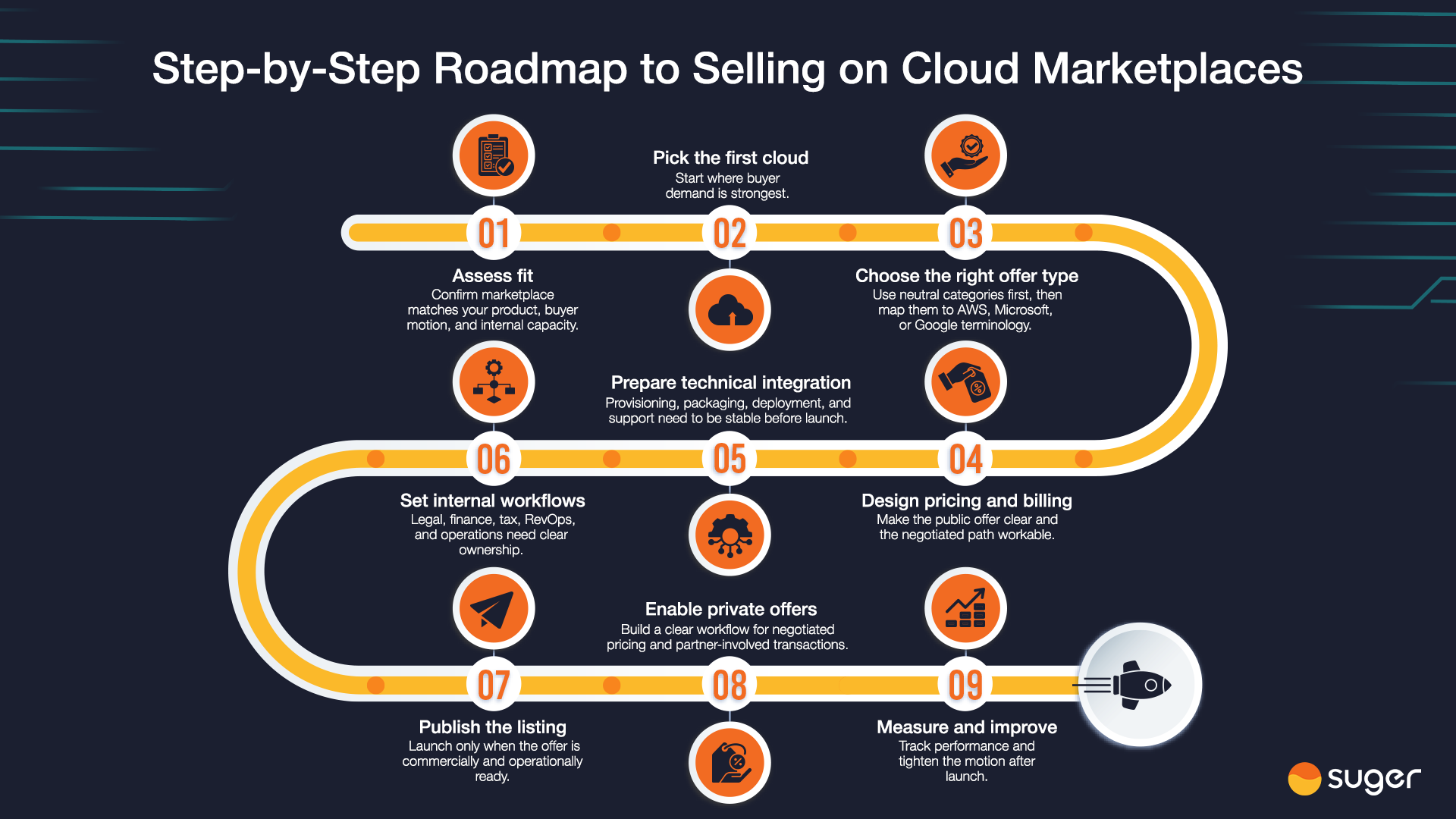
Step 1: Decide whether marketplace is the right channel for your product
Not every software application belongs in a hyperscaler ecosystem. Vendors need to first evaluate their Annual Contract Value (ACV) and target buyer's procurement habits. Products with very low ACVs, or those sold exclusively to small businesses, rarely return enough on the technical integration costs.
B2B enterprise software with complex sales cycles, high ACVs, and significant security review requirements is a better fit. If your sales organization frequently encounters stalled deals due to rigid procurement, or if prospects regularly ask about utilizing their committed spend agreements, marketplace can become commercially useful very quickly.
On the other hand, if your product is still finding product-market fit, your sales motion is not repeatable, or your buyers don't care how the transaction is routed, marketplace may not be the first place to invest.
We usually look at four questions:
- Are buyers asking for marketplace access?
- Does cloud alignment help close deals?
- Can the product be packaged in a marketplace-friendly way?
- Does the company have enough internal support to run the motion properly?
If the answer is mostly yes, marketplace is worth building seriously. If not, launching early may create more overhead than value.
Step 2: Choose the right marketplace first
Launching simultaneously across AWS, Azure, and Google Cloud strains engineering and revenue operations teams. Each platform has distinct API architectures, staging environments, and co-sell requirements.
The cloud-agnostic way to think about this is simple: start where buyer demand is strongest, where partnerships are most active, and where your product fits the platform best. That doesn't always mean starting with the biggest marketplace.
- Start with AWS Marketplace if your buyer base is already deep in AWS or you expect to use AWS's partner-mediated private offer model (CPPO).
- Start with Microsoft Marketplace if your customers are strongly Microsoft-led and you expect to use Microsoft's Multiparty Private Offer (MPO) model.
- If your product is a data analytics tool or open-source Kubernetes application, Google Cloud Marketplace typically offers the best strategic alignment.
The goal is to select the platform on which your engineering team focuses its integration efforts and on which your partnership team builds its first cloud alliance relationships.
Step 3: Align product, pricing, packaging, and billing model
This is where the marketplace offer needs to match how the product is actually sold. By this point, the team should already know whether the product is being brought to market as a SaaS, VM-based, or container/Kubernetes offer. The next step is to make sure the pricing model, billing logic, contract structure, and renewal path all support that format cleanly.
The goal is to adapt the existing model so buyers can transact, renew, and expand without confusion.
Step 4: Prepare technical integration and listing requirements
A listing is only credible if the product experience behind it works. For SaaS offers, this usually means provisioning, entitlement, onboarding, and any required fulfillment flows. For VM-based or Kubernetes-based products, it can mean image readiness, deployment packaging, cloud validation, and installation clarity.
The technical work varies by platform, but the operating principle is the same: a buyer should understand what they are buying and what happens after purchase.
This is also where the listing itself needs discipline. Clear product language, accurate requirements, compelling screenshots, and a clean onboarding path reduce confusion during buyer evaluation and make it easier for internal teams to support the deal post-purchase.
Step 5: Set up legal, finance, tax, and operational workflows
A cloud marketplace deal is still a real commercial transaction. It needs contract control, billing clarity, tax handling, internal approvals, and a clear post-sale process. If those workflows aren't defined before launch, the first serious deal usually exposes the gaps.
Legal needs to know which agreement framework will be used, when standard terms are enough, and when a negotiated private offer should take over. Finance needs clarity on billing structure, reporting, revenue recognition, and how marketplace transactions will be tracked alongside direct sales. Tax and operations teams need to understand where the transaction sits, what gets invoiced through the cloud provider, and what internal handoffs happen after purchase.
Step 6: Publish the listing
Publishing is the visible milestone, but not the main one. By the time the listing goes live, most of the important decisions should already be made. Product format should be clear, pricing should make sense, and internal workflows should be defined.
The listing should be:
- Clear enough for a buyer to understand quickly
- Specific enough to support evaluation
- Accurate enough that sales, partnerships, and customer success can stand behind it
- Complete enough that procurement or technical reviewers aren't left guessing
Teams must treat the listing like a commercial asset. It should reflect how the company wants the product to be understood in-market.
Step 7: Match pricing and contracting to your go-to-market motion
Marketplace packaging only works when the pricing and contracting model matches how the company actually sells. A public offer may be enough for a product-led motion where buyers can self-serve. A private offer is the better fit for a sales-led motion where pricing, terms, or contract length need to be negotiated. A partner-led motion may require a reseller or channel structure such as CPPO in AWS or MPO in Microsoft.
These motions are not mutually exclusive. One company can support all three at the same time. A SaaS company might use:
- A public offer to support PLG or standard purchasing
- A private offer for direct enterprise deals
- A partner-mediated private offer for reseller- or channel-led transactions
Step 8: Train sales, partnerships, and customer success teams
A published listing holds no value if the field sales team doesn't know how to position it. Sales needs to know when marketplace helps move a deal and when it doesn't. Partnerships need to know how it fits Cloud GTM, co-sell, and partner-led structures. Customer success needs to know what changes after a customer buys through marketplace instead of through a direct contract.
At a minimum, teams should know:
- When to introduce marketplace in a deal
- Which marketplace to use and why
- When to use public pricing versus a private offer
- What the customer experience looks like after purchase
- Who owns approvals and escalation when something changes
This is one of the clearest dividing lines between companies that "have a listing" and companies that sell through marketplace. The second group makes marketplace part of the field motion. The first waits for someone else to bring it up.
Step 9: Track performance after launch
Once the listing is live, measure whether marketplace is working as a channel. That means looking beyond page views or publication status.
The metrics that matter are tied to commercial use:
- Sourced or influenced pipeline
- Number of marketplace transactions
- Private offer volume
- Time to close when marketplace is involved
- Renewal and expansion activity
- Partner-led or cloud-led deal contribution
Keep the post-launch view simple at first. Track whether marketplace is being used in real deals, whether it's helping transactions move, and whether the internal workflow is holding up under pressure. Once volume grows, reporting can become more detailed.
Cloud Marketplace Private Offers: CPPO, MPO, and Partner-Led Deals
Public listings are useful, but most serious enterprise marketplace deals don't close on public pricing alone. In practice, SaaS teams need a way to tailor commercial terms without taking the deal outside the marketplace. That's where private offers come in.
What is a private offer?
A private offer is a marketplace deal created for a specific buyer on custom commercial terms. Instead of forcing the customer to purchase on the public listing terms, the seller can extend custom pricing and, depending on the platform, custom terms or contract structures.
AWS defines private offers as negotiated pricing and EULA terms for a specific buyer. Microsoft says private offers support custom terms, customized pricing for up to five years, proof-of-concept structures, and bundles of up to 10 products from the same vendor. Google Cloud says vendors can create private offers for specific customers for SaaS, VM, and Kubernetes products.
For SaaS companies, this is what makes marketplace commercially usable. A public listing creates a standard purchase path. A private offer gives the sales team room to structure the deal.
When to use private offers
Revenue operations teams need to establish internal rules for when sales reps deploy these custom agreements. Using them indiscriminately creates administrative overload; ignoring them jeopardizes large deals.
Use private offers when:
- The account is enterprise and expects negotiated commercial terms
- The deal needs custom pricing or discounting
- The term structure doesn't match the public listing
- The buyer wants a marketplace transaction but not a standard package
- The sales team needs to preserve the marketplace buying path without giving up deal flexibility
What are channel partner private offers?
This is where terminology needs to stay precise.
CPPO is an AWS-specific term — it stands for Channel Partner Private Offer. CPPO allows a channel partner to resell an ISV's product in AWS Marketplace after the ISV grants the partner a selling authorization; the partner then extends the private offer to the buyer.
Microsoft's comparable motion is called a Multiparty Private Offer (MPO). Microsoft says multiparty private offers let software partners and channel partners sell collaboratively through Microsoft Marketplace, with the customer purchasing through the partner-enabled marketplace motion.
Google Cloud Marketplace's equivalent is called a Marketplace Channel Private Offer (MCPO). Under the MCPO program, the ISV creates a reseller private offer plan that authorizes a channel partner to create private offers for end customers.
The names differ, but the commercial idea is similar across the big three: a partner is involved in taking the product to the customer, and the transaction is still executed through the marketplace rather than moved outside it.
8 Common Cloud Marketplace Mistakes to Avoid
Companies struggle because they treat marketplace as a publishing task, they launch before internal teams are ready, or they expect the listing itself to create momentum. It rarely works that way.
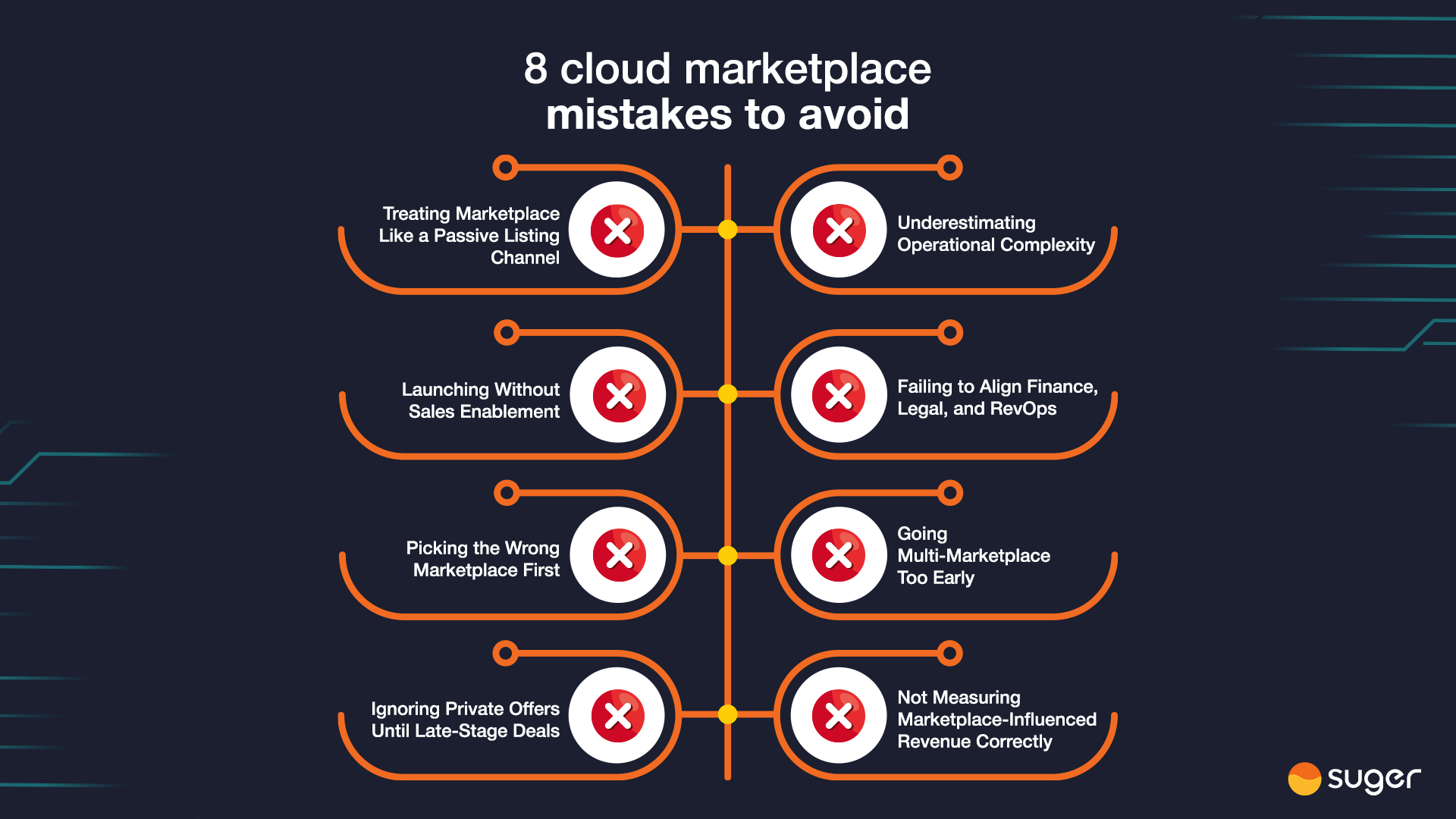
1. Treating marketplace like a passive listing channel
A live listing does not create a live marketplace motion. If sales, partnerships, and operations aren't using the channel in real deals, marketplace stays inactive even when the product is published.
2. Launching without sales enablement
If sales doesn't know when to use marketplace, it doesn't become a real channel. The listing goes live, but the field team isn't trained on when to introduce marketplace, when to use private offers, or how marketplace helps a deal move. The product is technically available, but commercially underused.
3. Picking the wrong marketplace first
Teams often default to the largest or most familiar marketplace rather than the one that best matches buyer demand, cloud relationships, and product fit. This creates unnecessary work and slows early traction. The better first choice is the marketplace most likely to support transactions soon, not the one that looks best on paper.
4. Ignoring private offers until late-stage deals
Many teams launch with public pricing only and wait until a real enterprise deal forces them to build private-offer workflows. That usually creates delays at the worst possible moment.
5. Underestimating operational complexity
Marketplace is not owned by one team. Product, sales, partnerships, finance, legal, customer success, and operations all have a role once deals begin moving through marketplace. If that internal coordination is missing, the process breaks down quickly.
6. Failing to align finance, legal, and RevOps
Marketplace becomes harder to scale when these teams are brought in too late. Finance needs clarity on billing and reporting. Legal needs clarity on terms, approvals, and exceptions. RevOps needs clarity on attribution, process, and ownership. If those teams aren't aligned early, every private offer, approval, or reporting question becomes harder than it should be.
7. Going multi-marketplace too early
Expanding to multiple marketplaces before the first one is working usually spreads internal resources too thin. Each platform has different onboarding, offer structures, and operational requirements. Scale usually comes after the first marketplace motion is working, not before.
8. Not measuring marketplace-influenced revenue correctly
Some organizations only count deals that are fully sourced through marketplace. That misses how the channel often works in reality — marketplace is frequently used later in the sales cycle to help close, contract, or route a deal through the buyer's preferred path. If you only measure direct marketplace sourcing, you'll undercount the real commercial impact.
How To Be Successful On Cloud Marketplace: Metrics and KPIs to Track
Launching a listing is a starting line, not a finish line. To transform a procurement channel into a predictable revenue engine, teams need rigorous data tracking. Marketplace needs to be measured as a commercial channel — the best reporting model looks at visibility, deal movement, offer usage, revenue contribution, renewal performance, partner impact, and internal speed.
Listing visibility metrics
Check whether buyers are actually finding and engaging with the listing. Views, traffic sources, click-through behavior, and page engagement all help show whether the listing is visible and relevant. These metrics are useful early on, especially right after launch, but they aren't proof of marketplace success on their own. Visibility tells you whether buyers are looking. It doesn't tell you whether marketplace is helping deals move.
Private offer metrics
Private offers are often the clearest sign that marketplace is being used in serious enterprise deals. Track how many private offers are being created, how many are accepted, how long they take to prepare, and how long they take to close. This shows whether the team is ready to support negotiated deals inside the marketplace channel or whether the workflow is slowing things down.
Pipeline and conversion metrics
Marketplace should show up in pipeline reporting. The key questions: is marketplace attached to active opportunities, do those deals convert at a stronger rate, and does the sales cycle change when marketplace is part of the motion? A marketplace program is much easier to justify when it can be tied to real opportunity movement rather than listing activity alone.
Marketplace-influenced revenue metrics
This is one of the most important areas to get right. SaaS teams undercount marketplace because they only measure revenue directly sourced through the marketplace. In practice, marketplace is often introduced later in the sales cycle to help complete a transaction. The better view is to track both revenue transacted through marketplace and revenue influenced by marketplace.
Renewal and expansion metrics
Marketplace performance shouldn't be judged only on first purchase. Know whether marketplace customers renew well, expand over time, and continue buying through the same channel. If marketplace is bringing in the right customers, that should show up in renewal rates, expansion revenue, and account growth after the initial transaction.
Partner and co-sell metrics
If marketplace is tied to cloud partnerships or reseller activity, the reporting should show it. Look at how many deals involve cloud or channel support, how those deals perform, and how much revenue comes from partner-influenced marketplace transactions. This helps show whether marketplace is strengthening the wider go-to-market motion rather than operating as a separate track.
Operational efficiency metrics
Marketplace also needs internal performance tracking — time to publish, time to create a private offer, approval turnaround, onboarding speed, and issue resolution all matter. These numbers show whether the channel is becoming easier to run as more deals come through.
Final takeaway
Cloud marketplaces have become a significant growth channel for SaaS companies, but they only work well when treated as more than just a listing. The opportunity lies in using marketplace to support enterprise buying, align with Cloud GTM, enable flexible deal structures, and build a cleaner commercial path for customers who already buy through AWS, Microsoft, or Google Cloud.
The teams that get value from marketplace start with buyer demand, choose the right platform, align product and pricing with the right offer model, prepare private-offer workflows early, and make sure sales, partnerships, finance, and operations are all working from the same plan.
That's where marketplace execution gets harder, and where Suger fits in. Suger gives SaaS companies the infrastructure to launch listings, manage complex private offers, and automate usage metering across AWS, Microsoft Azure, and Google Cloud. Instead of pulling engineering into custom marketplace integrations, revenue teams can stay focused on closing deals, supporting partners, and scaling marketplace sales.
When you're ready to build a real multi-marketplace revenue engine, Suger gives you the foundation to do it properly. Request a demo today.
FAQs About Cloud Marketplaces
What is a cloud marketplace? +
A cloud marketplace is a software buying and selling platform run by a cloud provider such as AWS, Microsoft, or Google Cloud. It lets software vendors list and sell products through the cloud ecosystems that buyers already use, with the transaction billed through the buyer's existing cloud account.
What are the benefits of selling on a cloud marketplace? +
For SaaS companies, the main benefits are commercial. Cloud marketplaces can make enterprise buying easier, support cloud and partner motions, enable private offers, and give buyers a purchasing route that fits existing cloud relationships — often shortening procurement cycles from months to weeks.
How do private offers work? +
A private offer is a custom marketplace deal created for a specific buyer. It allows the seller to offer custom pricing, terms, or contract structure while keeping the transaction inside the marketplace channel. AWS, Microsoft, and Google Cloud all support private offers with slightly different terminology.
What is a channel partner private offer? +
A channel partner private offer is a partner-led version of a private offer. In AWS, it is called a Channel Partner Private Offer (CPPO). In Microsoft, the equivalent is a Multiparty Private Offer (MPO). Google Cloud's version is called a Marketplace Channel Private Offer (MCPO). The naming differs, but the concept is similar: a partner is involved in the transaction while the deal still moves through the marketplace.
Can SaaS companies sell on AWS, Azure, and GCP at the same time? +
Yes. It comes down to whether the company is operationally ready to support multiple marketplaces. Each platform has its own onboarding, offer structures, and operating cadence. Many companies expand to a second or third marketplace only after the first one is working as a repeatable channel.
Which cloud marketplace is best for SaaS? +
There is no single best option for every SaaS company. The right choice depends on where buyers already spend, which cloud relationships matter most in deals, and how the product is delivered. AWS Marketplace is often the broadest starting point, but Microsoft Marketplace or Google Cloud Marketplace may be the better fit depending on the customer base.
Is AWS Marketplace only for AWS-native products? +
No. AWS Marketplace is not limited to products built only for AWS-native environments. It supports SaaS, AMI, container, ML, AI agent, data, and professional-services products. What matters more is whether the product can be sold and fulfilled through AWS Marketplace in a way that fits the platform's requirements.
What is the difference between a public listing and a private offer? +
A public listing uses standard pricing and terms that any eligible buyer can review and accept. A private offer is created for a specific account and includes custom commercial terms. Public listings create a standard buying path; private offers support negotiated enterprise deals.
How long does it take to launch on a cloud marketplace? +
It depends on the product type, platform, and internal readiness. A simple SaaS listing can move faster than a more technical offer that requires deeper packaging and validation. In practice, delays are often caused more by internal approvals and preparation — legal, finance, tax, and operational readiness — than by the marketplace review itself.
Do cloud marketplaces help with enterprise procurement? +
Yes — that is one of their main advantages. Cloud marketplaces can make software purchases easier to route through existing cloud relationships, helping with procurement, billing, and internal approval. Many enterprise buyers also have committed cloud spend that marketplace purchases can draw down against, removing the budget-approval step from the procurement cycle.
Published · Last reviewed
Written and maintained by the Suger team.
Spotted something out of date? Email support@suger.io and we will correct it.