
Sales just closed another seven-figure deal through AWS Marketplace. The customer’s burning down their committed cloud spend, the rep hit quota, and the C-suite is celebrating another win in the cloud era.

While everyone’s celebrating, Finance is staring at the contract in Salesforce and thinking:
- When do we recognize this revenue?
- Who’s the principal?
- How do we book the AR when AWS is doing the billing?
- Where does the marketplace fee go on the P&L?
- And how exactly are we supposed to reconcile this when the cash shows up in six weeks as part of a bulk disbursement with 20 other transactions?
The pattern repeats every quarter: Revenue gets recognized in January. Cash arrives in April. And the reconciliation? That’s happening across spreadsheets, marketplace portals, and your CRM at 11 PM on the last day of the quarter.
Introduction
This is the first chapter of a Finance Cloud Marketplace Playbook centered around one core problem:
Cloud marketplace accounting forces you to make consequential accounting decisions with incomplete information, reconcile transactions you don’t control, using systems that weren’t natively built for this.
By the end of this chapter, you should be able to:
- Identify where marketplace mechanics break traditional finance processes
- Understand the key accounting decisions you need to make
- Know what solving this systematically requires
Finally, we hope after reading this you’ll be celebrating a little too (why should Sales have all the fun?)
Why Cloud Marketplace Transactions Break Traditional Accounting
Cloud GTM breaks the link between revenue, cash, and ownership. Finance is still accountable for all three.
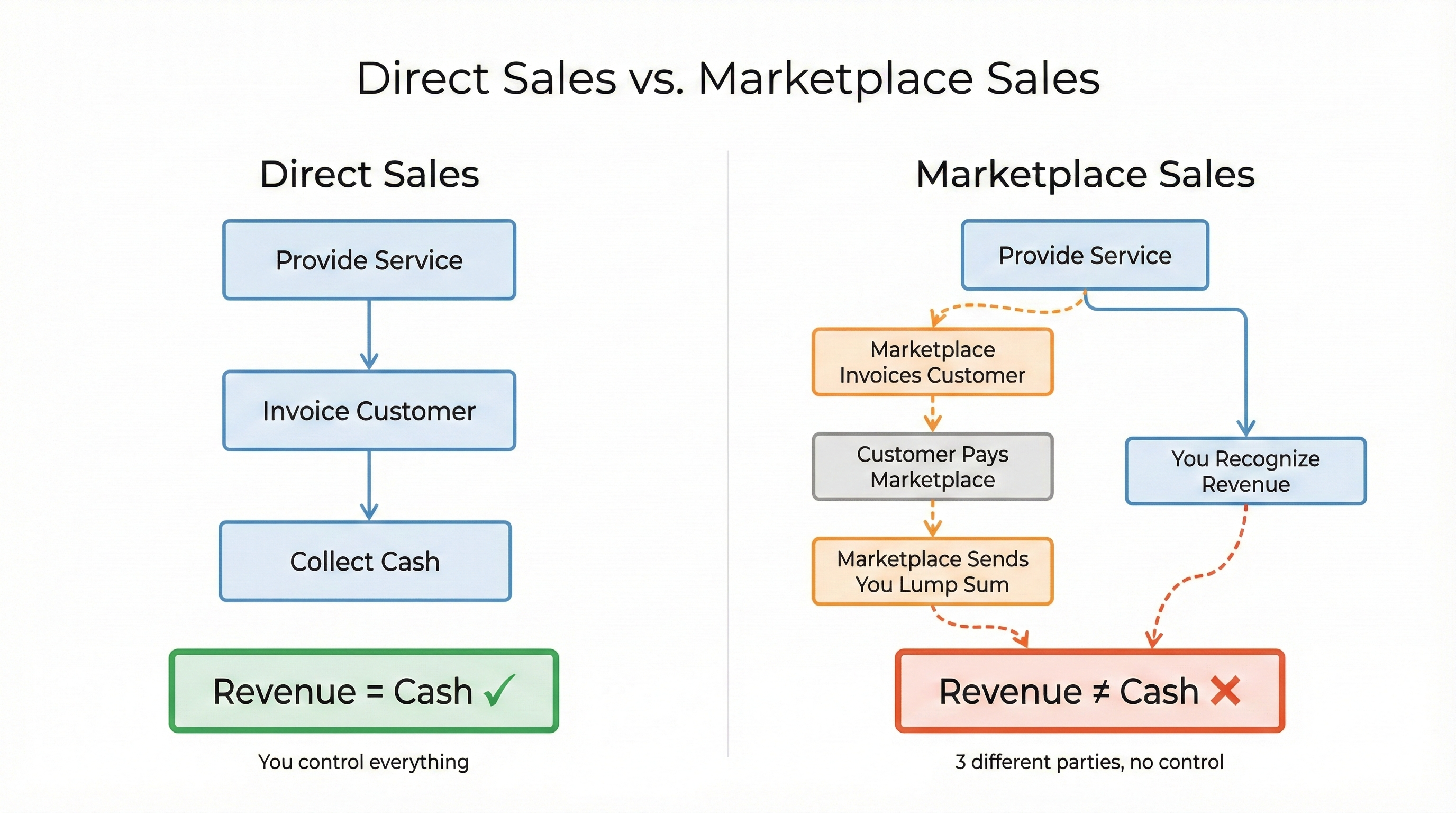
In traditional software sales, you deliver the service, you bill the customer and you collect the cash, so revenue recognition, accounts receivable, and cash flow make sense.
As shown in the illustration above, cloud marketplaces deals fracture that sequence entirely. Finance still has to recognize revenue correctly, reconcile cash, pass audits, and forecast accurately.
The following three problems expose where this broken model forces finance into impossible positions.
Revenue Recognition Challenges for Cloud Marketplaces
Marketplace revenue forces finance into subjective accounting decisions that current standards aren’t clear on.
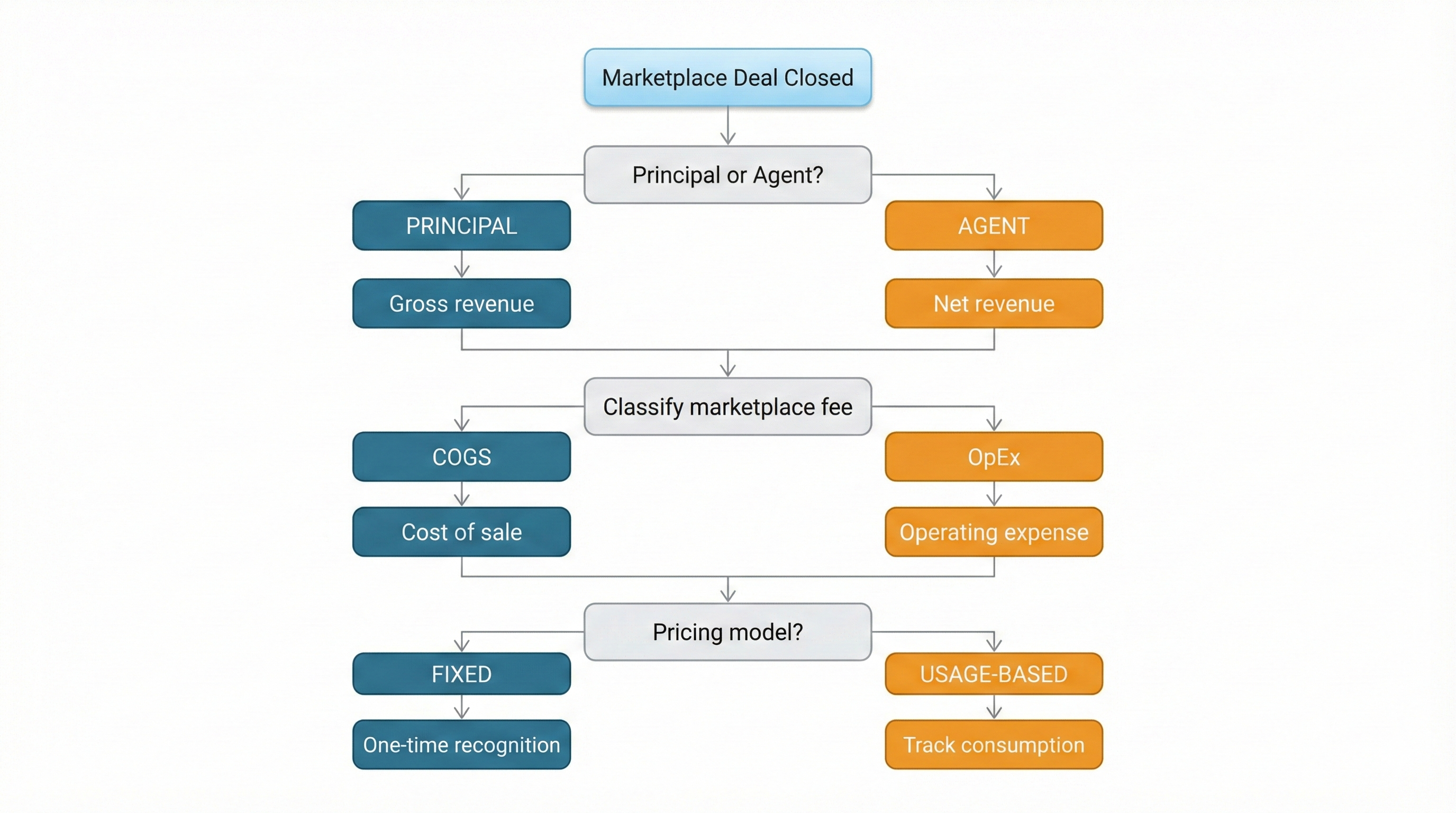
Marketplaces insert a third party into the transaction, creating three judgment calls that directly affect your reported revenue, margin profile, and valuation:
- Are you the principal or the agent?
- How do you classify the marketplace fee?
- How do you handle variable consideration?
Let’s examine each.
Principal vs. Agent Determination for Cloud Marketplace Deals
This is the most immediate and material accounting challenge for finance teams in a Cloud GTM model.
An entity is a principal (recognizing gross revenue) if it controls the good or service before transfer. Conversely, an agent (recognizing net revenue) merely arranges for another party to provide it.
The complexity deepens with multi-party offers (CPPOs or MPOs), which introduce a fourth party to the mix. Here, the ISV sells to a Channel Partner, who then sells to the end customer via the marketplace.
In practice, most SaaS vendors conclude they are the principal—they provide the product, set pricing, own the EULA, and handle service delivery. This means recognizing gross revenue and treating the marketplace’s cut as an expense. Finance teams must document their assessment against three primary indicators:
- Primary Responsibility for Fulfillment - The ISV manages uptime, support, and the EULA, even though the marketplace handles billing administration
- Inventory Risk - Marketplaces don’t purchase licenses to resell; they facilitate pass-through transactions
- Pricing Discretion - ISVs negotiate private offer pricing directly with customers
Why it matters: Gross vs. net presentation affects top-line revenue and growth metrics. This policy can materially impact valuations and benchmarks for high-volume sellers.
How to Account for Cloud Marketplace Fees on Your P&L
Once you’ve established principal status, the next question is: how do you treat the marketplace fee on your P&L?
Should fees be Cost of Goods Sold (COGS) or Operating Expenses (OpEx)? Industry practice is split according to GaapSavvy:
- 58% classify as S&M (operating expense)
- 42% classify as COGS
Our recommendation: We prescribe OpEx classification as best practice. Marketplaces function as sales channels, making the fee analogous to channel partner compensation. However, many teams default to COGS as more defensible. No explicit standard dictates treatment. Make a policy decision, document the rationale, maintain consistency, and prepare to defend it to auditors
Revenue Recognition for Marketplace Deals with Usage-Based Pricing
For usage-based or consumption pricing, you recognize revenue as usage happens, requiring real-time tracking and integration between marketplace metering data and your revenue systems. You must estimate variable consideration at contract inception, then update as actual usage data arrives. At period-end, you may need to accrue for unbilled usage—creating estimation risk on top of delayed data and deferred revenue schedules that multiply with each transaction.
Managing Cloud Marketplace Accounts Receivable and Cash Flow
When you account for revenue as principal, you must record AR for the full amount. But in marketplace sales, you didn’t invoice the customer and you don’t control collections. This creates three compounding problems:
- You need “ghost invoices” just to make your ERP work
- Cash timing is unpredictable and outside your control
- You’re exposed to collection risk you can’t monitor
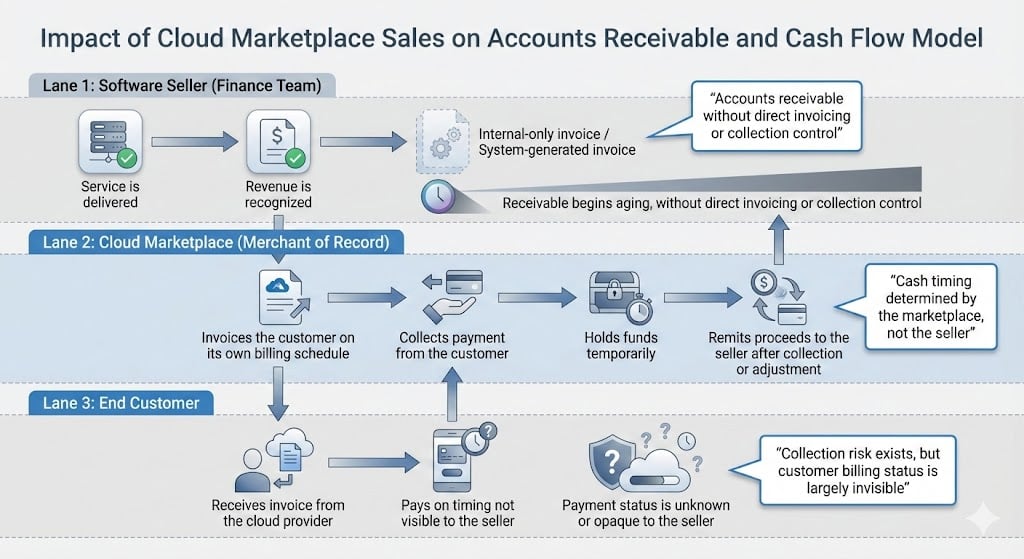
How to Create Invoices for Marketplace Transactions
When selling direct, you invoice the customer and manage collection. In marketplace sales, the cloud provider invoices the customer on your behalf as the merchant-of-record.
But you still need to record a receivable and track its collection. The result: you carry AR on your books for sales you didn’t bill, with limited visibility into the customer’s payment status.
The workaround: According to a GaapSavvy survey, 63% of companies create “dummy” or ghost invoices in their ERP.
You don’t have to send these to customers (they’re paying the cloud provider) but the invoices allow your system to:
- Log the receivable
- Book revenue
- Apply payments when cash arrives
Most companies list the end-customer name on these invoices and classify them as normal trade receivables, aligning with the economic reality that you’re owed money for delivering the service.
Understanding Marketplace Payment Timing and Cash Flow Impact
Creating dummy invoices is just the beginning. The cash flow timing creates a second layer of complexity.
Cloud marketplaces pay out funds on a delayed cycle:
- Customer is invoiced by the cloud provider (net 30, net 45, etc.)
- Cloud provider collects payment from customer
- Cloud provider remits your share after collection
Example of a typical cycle: January sale via Azure (net-30 terms) → Microsoft invoices in January → collects in February → pays you mid-March. Your books show A/R in January, cash receipt in March.
Magnitude of impact: For high-volume sellers at $100M+ marketplace revenue annually even 5 days of delayed payment equals significant lost interest income.
Handling Collection Risk in Cloud Marketplace Deals
The delayed cash flow would be manageable if you could at least track collection status. But you can’t.
While cloud providers perform credit checks, default risk still flows back to you:
- AWS/GCP: Only pay after collecting (you’re not paid if customer defaults)
- Azure: May pay before collection but will claw back amounts from future payouts if customer doesn’t pay
Cloud marketplaces share minimal customer billing and credit information. You often won’t know if a deal is on extended terms or facing collection issues until the payout is delayed. This makes cash forecasting difficult and may require opening support tickets to investigate specific unpaid accounts.
Reconciling Revenue Across Your Internal Systems
Without shared identifiers across systems, reconciliation shifts from accounting work to detective work.
For high-volume sellers, this is where operational pain becomes acute. The reconciliation challenge has three layers:
- No common identifier links your systems together
- Disbursements arrive as lump sums you must reverse-engineer
- Multi-currency deals multiply the complexity exponentially
Each layer compounds the others.
Reconciling Revenue Across CRM, Marketplace, ERP, and Bank
The fundamental problem is simple but crippling:
- CRM (Salesforce/HubSpot) shows a deal with an opportunity ID
- Marketplace portal shows a transaction with a marketplace transaction ID
- ERP (NetSuite/QuickBooks) shows revenue with an invoice number
- Bank shows a lump-sum deposit with a bank trace ID
There is no shared unique identifier linking all four. Finance teams must triangulate using customer names, amounts, and dates, none of which align perfectly.
How to Match Marketplace Disbursements to Individual Deals
When a $61,000 disbursement arrives, you don’t know if it represents:
- One deal from one buyer
- Three different transactions grouped together
- Partial payment on a larger entitlement
Most companies resort to spreadsheets, manually matching invoice amounts across buyers to figure out which deals sum to $61,000. Marketplaces provide some metadata (bank trace ID, invoice ID), but it’s inconsistent across platforms and rarely matches the identifiers in your other systems.
The net-to-gross reconciliation layer: The bank deposit shows the net amount (after marketplace fees). You need to:
- Identify which transactions the disbursement represents
- Add back the listing fee to calculate gross revenue
- Categorize the fee per your accounting policy
- Create appropriate journal entries
For companies selling across AWS, Azure, and GCP simultaneously—each with different fee structures and reporting formats—this manual work can add days or weeks to close cycles.
Reconciling Multi-Currency Cloud Marketplace Transactions
Selling globally introduces foreign exchange as another reconciliation variable. Marketplaces apply exchange rates (typically Bloomberg) at invoice time, not offer acceptance.
If you close a ¥700,000 deal on January 1 but the invoice goes out January 15, you’re exposed to FX fluctuation between those dates. The ISV bears the exchange risk and must reconcile FX impacts across three different moments—all potentially at different rates:
- Contract date
- Invoice date
- Cash receipt date
How to Solve Marketplace Finance Challenges At Scale
The three themes above aren’t theoretical, they’re daily reality for finance teams managing marketplace revenue. At low volumes, you can muscle through manually. Spreadsheets work. Close takes an extra day, but it’s manageable. As deal volume on marketplace grows, manual processes break down entirely. You need automation or you’re looking at materially longer close cycles, audit risk, and potential revenue leakage.
The Three Pillars of Cloud Marketplace Finance
Solving marketplace finance at scale requires three foundational elements:
Pillar 1: Clear Accounting Policies
Before you can automate anything, you need documented decisions on the judgment calls:
- Principal vs. agent determination (with supporting analysis for auditors)
- Marketplace fee classification: S&M or COGS?
- Revenue recognition timing: contract signature or offer acceptance?
- How marketplace fees impact SaaS metrics (CAC, gross margin, ARR)
- Bad debt reserve methodology when you don’t control collections
- Multi-entity revenue booking rules for global operations
These aren’t one-time decisions. As you expand into new marketplaces or new deal structures (CPPO, usage-based), you’ll revisit these policies.
Pillar 2: Unifying Fragmented Data Into a Single Source of Truth
The core problem is data fragmentation across disconnected systems. You need a unification layer that:
- Aggregates marketplace data across AWS, Azure, GCP, and emerging platforms
- Links marketplace transactions to CRM opportunities with a common identifier
- Maps disbursements to specific entitlements
- Tracks net-to-gross reconciliation automatically
- Provides visibility into payment status and timing
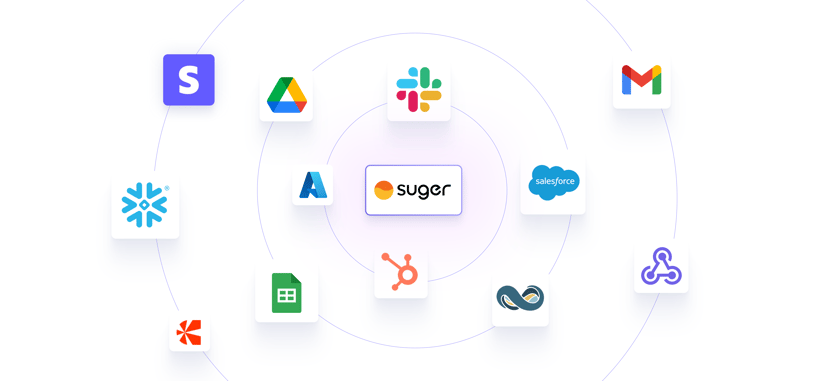
This is where platforms like Suger function as the connective tissue. Suger pulls data from marketplace APIs, links it to your CRM records (Salesforce, HubSpot), and prepares the accounting entries your ERP needs.
Instead of manually matching a $100,000 bank deposit across three spreadsheets, the system automatically maps: Marketplace disbursement → specific entitlements → CRM opportunities → ERP invoices
Suger’s revenue record APIs track disbursements, link them to entitlements, and expose webhook notifications when cash arrives—turning the lump-sum matching problem into a structured data flow.
Pillar 3: Automating Marketplace Revenue Workflows
The goal isn’t just visibility, it’s eliminating manual steps entirely. Best-in-class implementations automate the order-to-cash cycle:
- Offer Accepted → Auto-create invoice in NetSuite (gross amount) + Record marketplace fee (OpEx or COGS per your policy) + Update Salesforce opportunity stage
- Disbursement Received → Match to entitlement → Apply payment in ERP → Close AR
- Exception Detected → Flag late payments, discrepancies, FX variances for manual review
Suger’s workflow builder lets you construct these automations visually, connecting marketplace events to actions in your CRM and ERP. The integrations with Salesforce, HubSpot, and NetSuite are native, and custom workflows are supported via API.
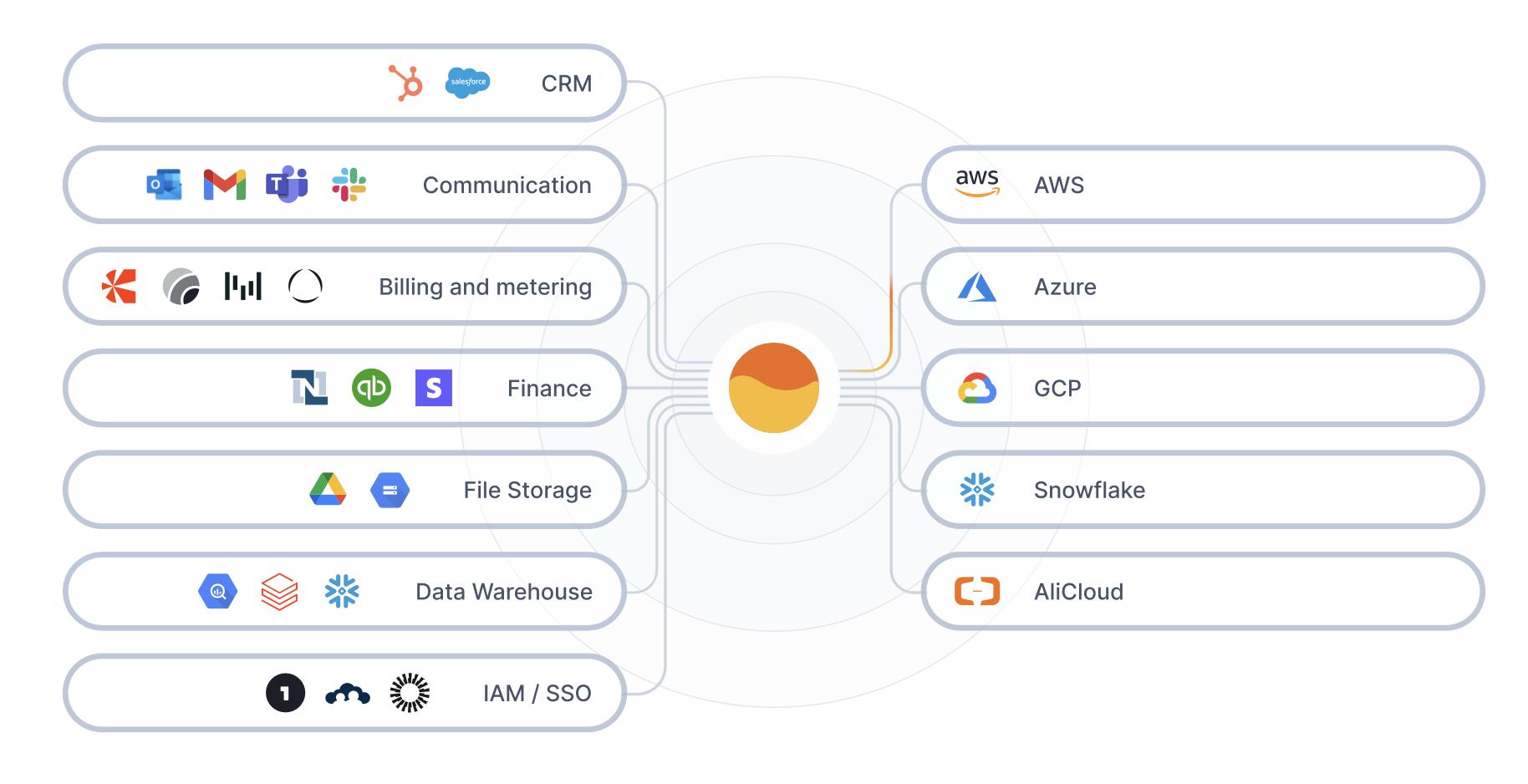
This turns reconciliation from a detective work into an automated process with exception-based reviews, the way month-end close should work.
Closing Note
According to benchmarks, top SaaS companies transact 20-40% of new bookings through marketplaces. For some, it’s over 50%.
When marketplace revenue reaches that scale, the finance challenges we’ve outlined stop being occasional inconveniences and start being systemic risks:
- Audit findings on unsupported revenue recognition policies
- Material weaknesses in internal controls over financial reporting
- DSO inflation that masks underlying collection problems
- Revenue leakage from reconciliation errors that compound over time
- Extended close cycles that delay board reporting and strategic decision-making
The fix isn’t more spreadsheets or more headcount. It’s treating marketplace revenue the way you treat any other significant revenue stream: with clear policies, unified data, and automated processes.
If you’re still reconciling marketplace revenue manually at 11 PM on the last day of the quarter, you’re not solving a temporary problem, you’re managing a permanent one badly.
Ready to go deeper?
We’ve built a comprehensive Finance Marketplace Best Practices Checklist that walks through everything you need to look out for.
Stay Updated
Get the latest Cloud GTM insights, product updates, and marketplace strategies delivered to your inbox.